
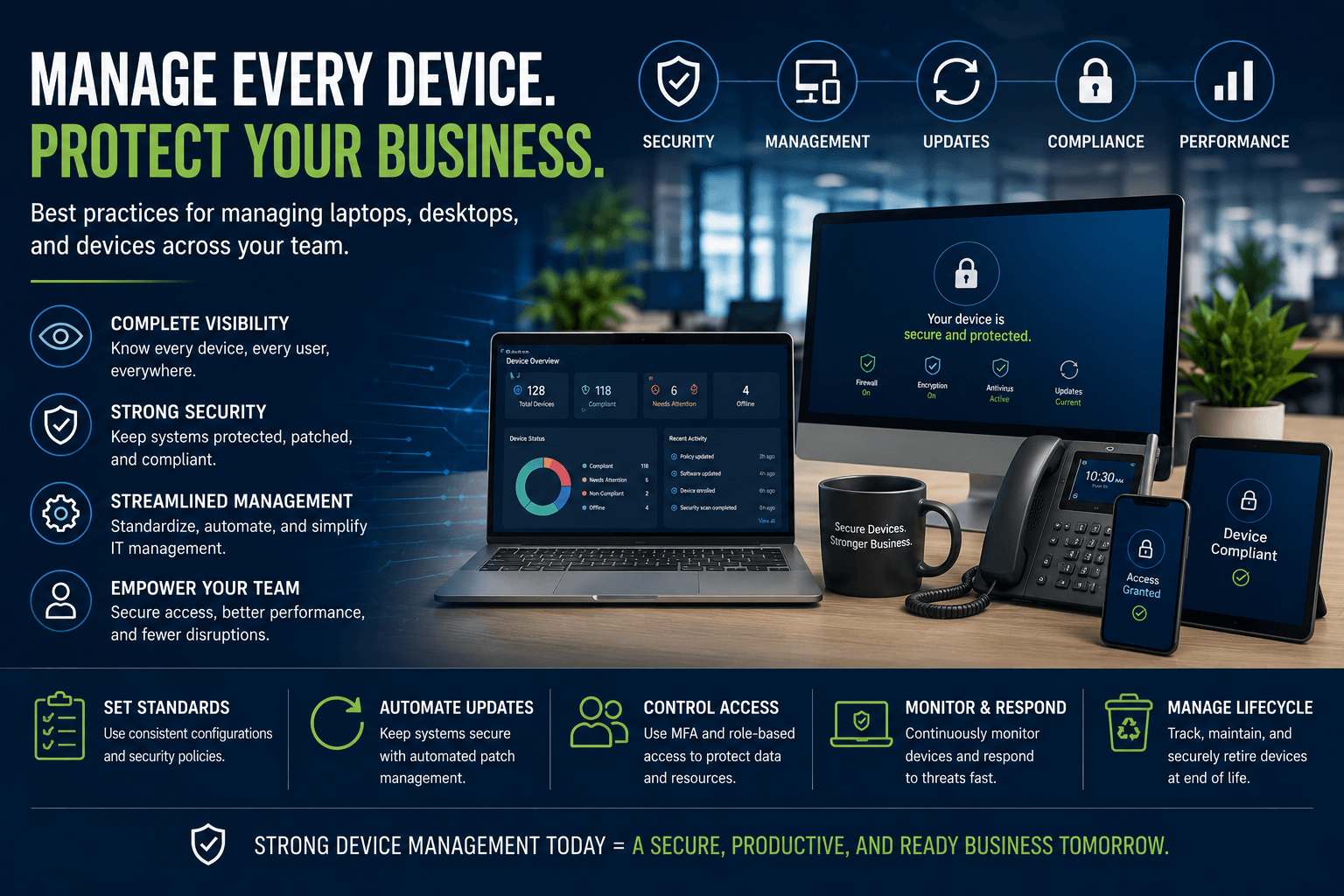
Most businesses have more devices connected to their environment than they realize.
- Laptops
- Desktops
- Phones
- Tablets
- Remote workstations
- Personal devices
And every one of them is a potential entry point. The problem is that many organizations still manage devices reactively:
- Devices are deployed without standards
- Updates happen inconsistently
- Old systems stay active too long
- Employees use personal devices without oversight
At first, it feels manageable. Until:
- Laptops are lost
- A phishing attack succeeds
- An unpatched system gets compromised
- A former employee still has access
That’s when businesses realize device management isn’t just an IT issue anymore.
- It’s a cybersecurity issue
- An operational issue
- And increasingly, a business continuity issue
Endpoint Management Has Changed
There was a time when most business devices stayed inside the office. That’s no longer true.
Today’s workforce is:
- Hybrid
- Remote
- Mobile
- Cloud-connected
According to Microsoft’s Zero Trust guidance for remote and hybrid work, organizations must assume devices and users may operate outside traditional network boundaries and implement continuous monitoring and policy enforcement accordingly.
That means device management now requires:
- Visibility
- Standardization
- Security controls
- Ongoing monitoring
Not just occasional support tickets.
Standardization Matters More Than Most Companies Think
One of the biggest mistakes businesses make is allowing every employee’s setup to evolve differently over time.
Different:
- Operating systems
- Security tools
- Software versions
- Device configurations
That creates:
- Support complexity
- Security gaps
- Inconsistent performance
Strong device management starts with standardization.
That includes:
- Approved hardware models
- Standard operating system configurations
- Consistent endpoint protection
- Unified patch management
- Centralized identity and access policies
When environments are standardized:
- Problems are easier to identify
- Security policies are easier to enforce
- Devices are easier to replace and support
And users experience fewer disruptions.
Identity and Access Control Are Critical
Modern cybersecurity is increasingly identity-driven. Attackers often don’t “hack” devices anymore.
They use:
- Stolen credentials
- Session hijacking
- Weak passwords
- Unmanaged devices
That’s why businesses should implement:
- Multi-factor authentication (MFA)
- Conditional access policies
- Role-based permissions
- Device compliance requirements
Organizations using unmanaged devices significantly increase exposure to ransomware and credential-based attacks.
This becomes especially important in hybrid and remote work environments.
Patch Management Is Not Optional
Unpatched systems remain one of the most common causes of compromise. Businesses often delay updates because:
- Employees are busy
- Restarts are inconvenient
- Legacy applications create compatibility concerns
But delayed patching creates exposure windows that attackers actively target. Effective device management should include:
- Automated patch deployment
- Scheduled update policies
- Firmware and driver management
- Regular vulnerability review
This applies to:
- Laptops
- Desktops
- Mobile devices
- IoT and smart office devices
Outdated devices don’t just create operational issues. They create risk.
BYOD Can’t Be Ignored Anymore
Whether businesses officially allow it or not, employees are already using personal devices for work.
According to recent reports, many organizations that prohibit BYOD still have employees using personal devices and hotspots.
That creates a major visibility problem. Without proper controls:
- Personal devices may lack encryption
- Systems may not be patched
- Malware protections may be missing
- Sensitive company data may be stored locally
Organizations implementing BYOD strategies should have:
- Clear acceptable-use policies
- Endpoint management tools (MDM/UEM)
- Remote wipe capabilities
- MFA requirements
- Data separation policies
NIST-aligned BYOD guidance emphasizes the importance of endpoint management, encryption, remote wipe capabilities, and ongoing monitoring for devices accessing corporate resources.
Visibility Is Everything
You can’t secure what you can’t see. One of the biggest challenges businesses face is simply maintaining accurate visibility into:
- Active devices
- Ownership
- Compliance status
- Installed software
- Security posture
That includes knowing:
- Which devices are missing updates
- Which users still have access
- Which endpoints haven’t checked in recently
Poor endpoint visibility creates “ghost devices” systems that remain connected or authorized long after they should have been removed.
This is one reason unified endpoint management (UEM) platforms have become so important.
Device Lifecycle Management Matters
Many businesses keep devices in production for too long. The problem is that aging hardware often means:
- Reduced performance
- Security limitations
- Unsupported operating systems
- Higher failure rates
Good device management includes:
- Asset tracking
- Hardware lifecycle planning
- Warranty monitoring
- Secure decommissioning
And secure decommissioning matters more than most organizations realize. Retired devices should:
- Be wiped properly
- Removed from management systems
- Disconnected from identity platforms
- Verified as deprovisioned
Otherwise, old devices can continue creating security exposure long after they leave the office.
Security Training Is Part of Device Management
Technology alone isn’t enough. Employees remain one of the biggest risk factors in any environment.
Strong device management strategies should include:
- Security awareness training
- Phishing education
- Remote work best practices
- Clear reporting procedures for lost or stolen devices
According to multiple BYOD security studies, user education remains one of the most important controls for reducing endpoint-related risk.
Because even the best tools fail if users don’t understand the risks.
The Goal Is Stability, Security, and Visibility
Good device management isn’t about controlling people. It’s about creating an environment that is:
- Predictable
- Secure
- Supportable
- Scalable
The organizations that manage endpoints effectively experience:
- Fewer security incidents
- Faster support resolution
- Better user experiences
- Lower long-term IT costs
And most importantly, they reduce the operational chaos caused by unmanaged growth.
Device Management Is Often the Cause of Bigger Problems
Most businesses don’t think much about device management until something goes wrong.
- Lost laptop
- Ransomware incident
- A former employee is still logging in
- A remote worker connecting from an unprotected device
That’s usually when the gaps become visible. Modern IT environments require more than just “having devices.”
They require:
- Visibility
- Policies
- Monitoring
- Security
- Lifecycle management
Because today, every endpoint is part of your business infrastructure. And every unmanaged endpoint is a potential liability.
Are you looking for a clean audit of all your devices? We can help.