
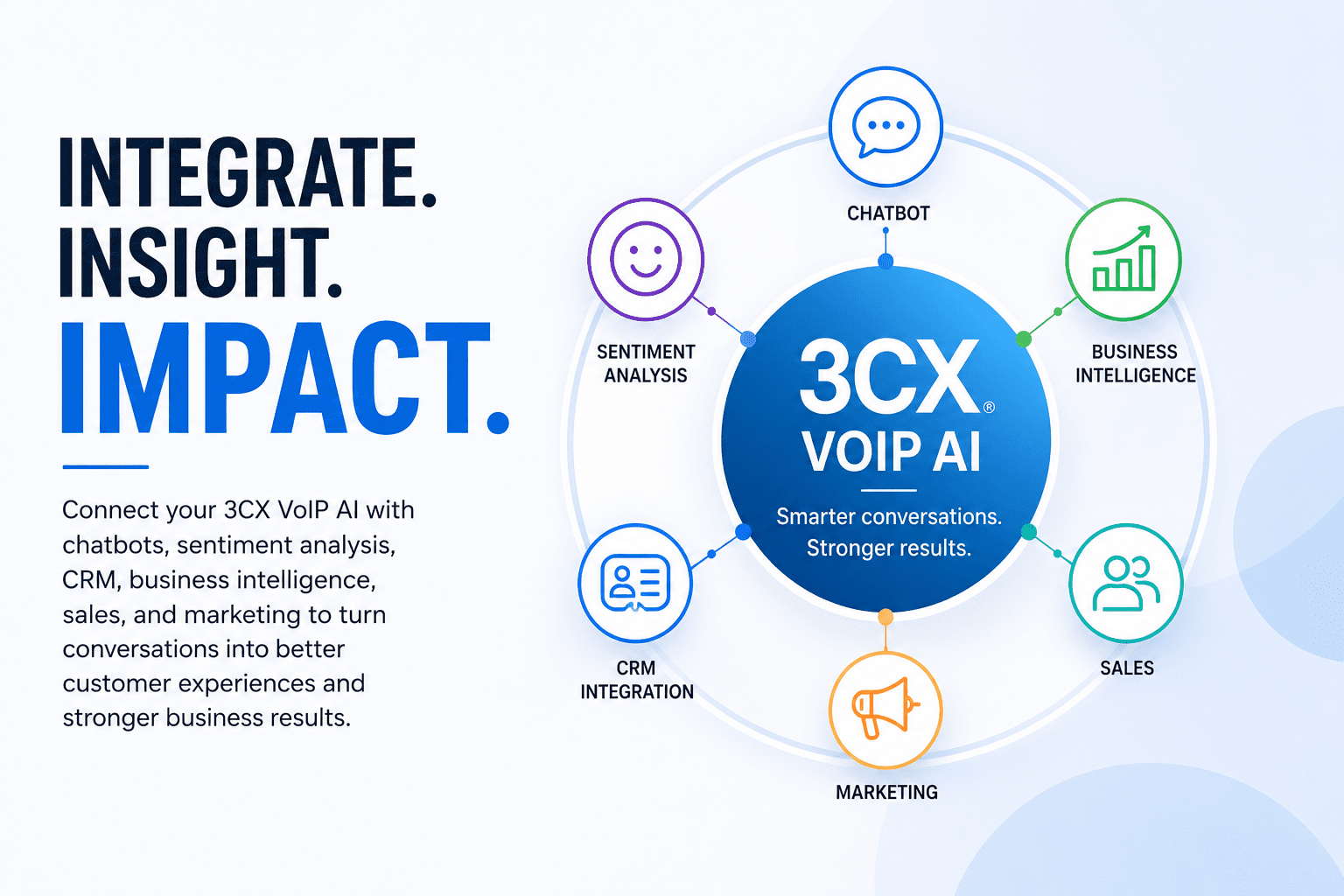
Smarter Calls. Better Sales. Stronger Marketing.
Most businesses still think of their phone system as a phone system.
- Calls come in.
- Calls go out.
- Maybe there’s voicemail, call routing, and a mobile app.
But modern VoIP, especially platforms like 3CX, can do much more than connect conversations.
When implemented correctly, VoIP can become a source of business intelligence, customer insight, sales enablement, marketing feedback, and operational improvement.
That’s especially true as AI features become more common in business communication platforms.
3CX, for example, now offers AI transcription, call summaries, speaker identification, and sentiment-related insights that help teams better understand customer conversations and agent performance.
The real value, though, doesn’t come from AI transcription alone. It comes from connecting those insights to the rest of your business.
Your Phone System Is Full of Data
Every customer call contains information. Not just what someone said, but:
- Why they called
- What problem they had
- How they felt
- Whether the issue was resolved
- Whether there was a sales opportunity
- Whether follow-up is needed
Traditionally, most of that information disappeared when the call ended. Maybe someone added a note to the CRM. Maybe they didn’t.
O a sales lead was followed up on. Maybe it got lost. AI changes that.
With transcription and call summaries, customer conversations become searchable, reviewable, and easier to connect with sales, service, and marketing workflows.
3CX describes its AI transcription, which converts calls and voicemails into text, creates summaries, identifies speakers, and surfaces follow-up items without replaying recordings.
That matters because your phone system is no longer just a communication tool. It becomes a data source.
It Starts with the Chatbot
A chatbot is often the first point of contact for a website visitor.
It answers basic questions, routes inquiries, collects information, and helps determine whether someone needs to speak with a live person.
But the experience breaks down when chat and voice are disconnected. A customer may explain their issue in chat, then switch to a call, and must start over.
That’s frustrating.
3CX Live Chat is designed to let website visitors move from chat to voice or video directly in the browser, reducing friction when a simple chat conversation needs to become a real conversation.
That’s where integration matters. When your chatbot and VoIP system work together, your team can:
- See conversation history before answering
- Understand why the customer is calling
- Route the call to the right person
- Avoid making the customer repeat themselves
- Capture the full customer journey from chat to call
This is the difference between “we have a chatbot” and “we have a connected customer experience.” That is a huge difference that your customers will appreciate.
Sentiment Analysis Turns Conversations into Insight
Sentiment analysis helps identify emotional tones in customer conversations.
- Are customers frustrated?
- Confused?
- Satisfied?
- Ready to buy?
- At risk of leaving?
Microsoft describes sentiment analysis as the ability to interpret customer emotions, improve engagement, and support better decision-making across customer interactions.
For businesses, this can be extremely valuable. When sentiment data is connected to VoIP and customer workflows, it can help identify:
- Recurring service problems
- Frustrated customers who need escalation
- Strong sales conversations
- Training opportunities for team members
- Marketing messages that are creating confusion
3CX’s AI analytics and reports also include mood analysis and call summaries to help organizations identify trends across customer interactions and agent performance.
That turns individual conversations into patterns. And patterns are where business intelligence begins.
Business Intelligence Needs Voice Data
Most business intelligence systems rely on structured data.
- Sales numbers.
- Website traffic.
- Ticket volume.
- Close rates.
- Campaign performance.
But voice conversations are often left out. That’s a problem.
Your phone calls may contain the clearest signals about:
- What customers actually care about
- Which objections prospects keep raising
- Which services create confusion
- Where customers experience friction
- What language should your sales team use
When VoIP AI data is connected to business intelligence tools, leadership can move beyond anecdotes.
Instead of saying, “We think customers are asking about this,” you can begin to see trends from actual conversations.
For example:
- Are calls about pricing increasing?
- Which customers mention cybersecurity more often?
- Do prospects seem confused about VoIP features?
- Are support calls tied to the same recurring issue?
- Are certain campaigns driving higher-quality conversations?
This is where AI-powered VoIP becomes more than a phone system. It becomes a feedback loop.
Your Sales Teams Need Better Context
Sales conversations rarely occur on a single channel. A prospect may:
- Visit your website
- Chat with a bot
- Download a resource
- Talk to sales
- Receive a follow-up email
- Revisit the site later
If your systems are disconnected, your sales team only sees part of the story. That creates missed opportunities.
3CX offers CRM integration with platforms such as Salesforce, Zoho, Zendesk, and Freshdesk, as well as APIs for custom integrations.
When VoIP, CRM, chatbot, and AI transcription work together, sales teams can:
- Review call summaries quickly
- Capture action items automatically
- Understand customer sentiment
- See prior chat history
- Log calls to the correct contact or opportunity
- Follow up with more relevant messaging
This helps sales teams spend less time reconstructing conversations and more time moving opportunities forward.
Marketing Gets Better Feedback from These AI Systems
Marketing teams often rely on analytics, clicks, forms, and campaign reports. That data is useful.
But it doesn’t always tell you what people are actually saying. VoIP AI can help close that gap.
By analyzing call transcripts and summaries, marketing teams can identify:
- Common questions from prospects
- Messaging that resonates
- Confusing website content
- Services people ask about most often
- Objections that should be addressed in campaigns
For example, if prospects repeatedly ask whether VoIP integrates with Microsoft Teams or CRM systems, that should influence website content, sales collateral, and campaigns.
If customers frequently raise cybersecurity concerns during sales calls, that may signal an opportunity to launch a campaign focused on secure communications.
This is how voice data supports smarter marketing.
Customer Service Becomes More Proactive
Customer service improves when teams understand what is happening before issues escalate.
AI-powered call summaries, sentiment trends, and integrated chat history help managers identify:
- Which customers may need follow-up
- What issues are recurring
- Which agents may need support
- What workflows are slowing resolution
Gartner notes that AI use cases in customer service continue to expand, including conversational AI, customer interaction analysis, and agent support workflows. Gartner also predicts that by 2028, at least 70% of customers will use conversational AI to start their customer service journey.
That doesn’t mean AI replaces people.
In fact, Gartner has also reported that many customers remain concerned about AI in customer service, especially when it creates barriers to reaching a human.
That’s the lesson. AI should improve customer experience, not get in the way of it.
The goal is not to automate everything.
The goal is to make every handoff smoother, every conversation more informed, and every follow-up more useful.
Why This Requires the Right IT Partner
Connecting VoIP AI with chatbot, CRM, business intelligence, sales, and marketing systems sounds simple.
It usually isn’t. Done poorly, it can create:
- Data silos
- Duplicate records
- Security gaps
- Inaccurate reporting
- Poor user adoption
- Compliance concerns
That’s why this work needs to be handled strategically.
This aligns directly with our approach to managed IT, VoIP, cybersecurity, and cloud solutions. Businesses need communication systems that are secure, integrated, and aligned with how their teams actually work.
The right strategy should address:
- System integration
- Data flow
- Security and access control
- Reporting needs
- User training
- Ongoing support
Because the value of AI depends on the quality of its environment.
VoIP AI Should Not Be Treated as a Standalone Feature
It should be part of a larger business strategy. When connected properly, your VoIP platform can support:
- Better customer service
- Smarter sales follow-up
- Stronger marketing insight
- More useful business intelligence
- Better visibility into customer sentiment
But when it sits in a silo, much of that value is lost. Modern communication systems should do more than connect calls.
They should help your business understand what customers are saying, what your team needs, and where the next opportunity is.
That’s the real promise of integrating VoIP AI with the rest of your business. Ready for a better customer experience, let’s chat.