
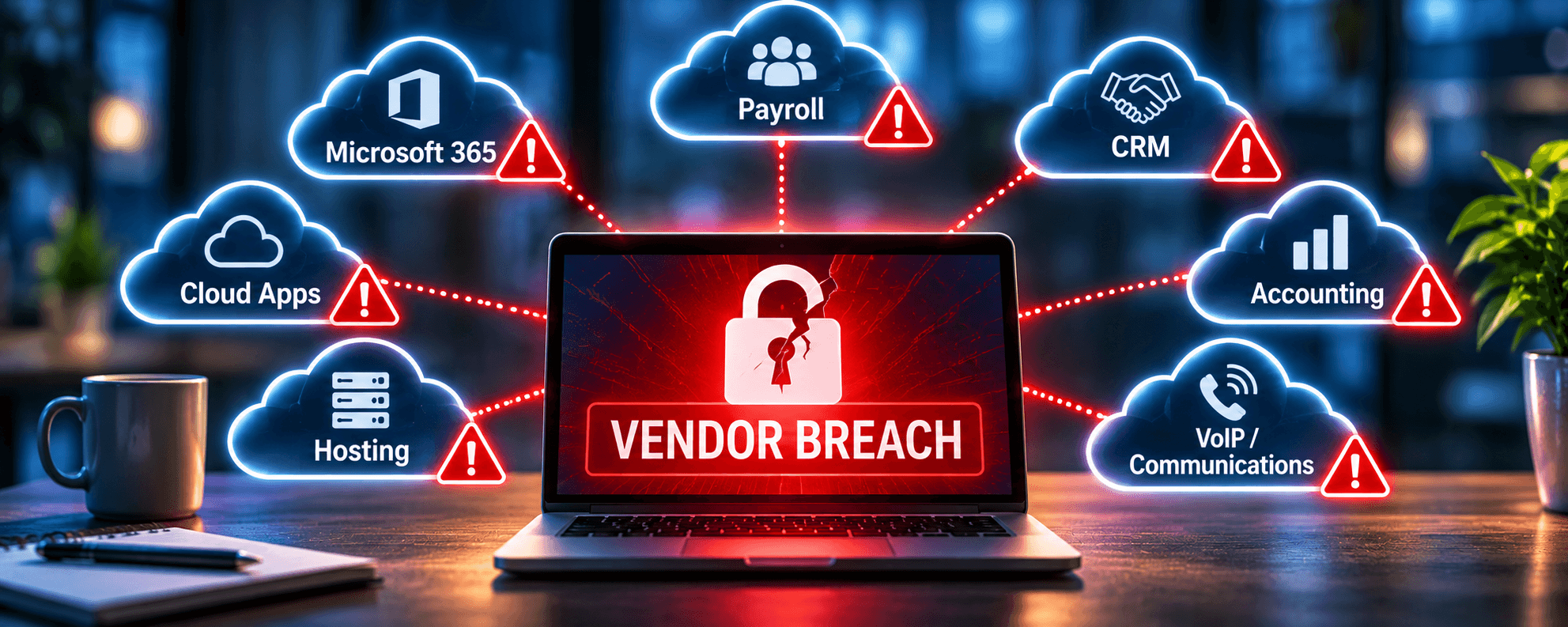
TL;DR: Your Vendor’s Cybersecurity Problem Can Become Yours
Your business may have strong cybersecurity, but a breach involving a payroll provider, SaaS platform, cloud service, or other vendor can still expose sensitive information or disrupt operations.
Third-party risk management means knowing which vendors have access to your systems and data, evaluating their security practices, limiting unnecessary access, and preparing for outages or breaches.
The bottom line: You can’t control every vendor’s cybersecurity, but you can control how much risk your business accepts and how prepared you are when something goes wrong.
Your business could have excellent cybersecurity.
- Strong passwords.
- Multifactor authentication.
- Updated firewalls.
- Endpoint protection.
- Employees who think before clicking suspicious links.
Congratulations. You’re doing a lot of things right. But what happens when a company you trust gets hacked?
Not your company.
- A payroll provider.
- Your accounting software vendor.
- A cloud hosting company.
- Your customer management platform.
- Or the software provider that has access to sensitive business information.
Suddenly, your cybersecurity problem isn’t something that happened inside your network.
It’s something that happened to someone else’s network, and now it’s your problem.
That’s the uncomfortable reality of modern business technology.
We’ve become increasingly dependent on third-party vendors, cloud applications, and Software-as-a-Service (SaaS) platforms.
And while these technologies make businesses more efficient, they also introduce risks that many organizations aren’t actively managing.
The question isn’t simply whether your business is secure.
It’s whether the companies you depend on are secure, and what happens to your business when they’re not.
Your Business Has More Cybersecurity Dependencies Than You Think
Think about how many outside companies have some connection to your business.
Your organization might use:
- Microsoft 365 for email, documents, and collaboration.
- A cloud-based accounting or payroll platform.
- A customer relationship management (CRM) system.
- A third-party payment processor.
- Cloud hosting and data storage providers.
- A VoIP or business communications platform.
- Industry-specific software.
- Outside IT consultants and support vendors.
- AI-powered tools connected to company information.
Each of these relationships creates a dependency.
Some vendors store your data. Others process financial transactions, manage customer information, or connect directly to your business systems.
And some have privileged access to your environment.
That’s where third-party cybersecurity risk becomes a business issue.
The National Institute of Standards and Technology (NIST) defines cybersecurity supply-chain risk management as the process of identifying, assessing, and mitigating risks associated with interconnected technology products and services.
In simpler terms, it’s about understanding who and what your business depends on, how those relationships could create security problems, and how you manage exposure.
Your business can inherit risk from a vendor without ever realizing it.
When a Vendor Gets Hacked, the Damage Doesn’t Always Stay with the Vendor
Imagine discovering that your payroll provider has experienced a cybersecurity breach.
Your own network hasn’t been compromised.
Your firewall is working. Employees haven’t clicked anything suspicious. Your internal systems are operating normally.
But the vendor may have access to employee names, addresses, Social Security numbers, banking details, and other sensitive information.
Now your business has questions to answer.
- Was your employees’ information exposed?
- Are you required to notify anyone?
- Does the incident create regulatory or contractual obligations?
- Could payroll operations be disrupted?
- And how do you explain the situation to employees who trusted your business with their information?
That’s one possible scenario.
Now imagine your CRM provider is compromised, exposing customer information.
Or your cloud software vendor suffers a ransomware attack that makes a critical application unavailable.
Or a vendor’s compromised credentials provide attackers with access to your environment.
These incidents differ, but they share an important characteristic. The original security failure may happen somewhere else. The business consequences can land squarely on your desk.
Depending on the circumstances, those consequences can include operational downtime, exposed information, financial losses, legal expenses, regulatory scrutiny, and damage to customer trust.
Even if a vendor is responsible for its own security failures, your organization may still have obligations to customers, employees, regulators, or business partners.
The SaaS Convenience Trap
Software-as-a-Service has transformed how businesses operate.
Instead of purchasing servers and installing applications locally, companies can subscribe to cloud-based platforms and access them from virtually anywhere.
That’s a tremendous advantage.
- Less infrastructure to maintain.
- Easier collaboration.
- Faster deployment.
- More flexibility.
But convenience can also create a false sense of security.
People tend to assume that because a major software company hosts an application, everything associated with it is automatically protected.
Unfortunately, that’s not how cybersecurity works. Cloud and SaaS security often involve shared responsibilities.
The provider may manage the underlying platform, while your organization remains responsible for user access, account security, data governance, and proper configuration.
Those responsibilities vary by service and contract.
Consider what happens when:
- Former employees retain access to cloud applications.
- A third-party integration receives excessive permissions.
- Sensitive information is shared more broadly than intended.
- Employees connect unauthorized applications to company accounts.
- A critical SaaS provider experiences a prolonged outage.
- A compromised vendor account is used to access your information.
Your cloud provider may be doing everything it can to secure its infrastructure.
But that doesn’t eliminate your responsibility to manage how your organization uses the service.
This is one reason predictive and proactive Cybersecurity Services emphasize identity management, security monitoring, vulnerability management, and proactive oversight.
Security must extend beyond your office walls.
Your Vendors May Have Vendors You Don’t Know About
Here’s where things get even more interesting.
- Vendors have vendors, too.
- Payroll providers might use a separate cloud hosting company.
- CRM platforms may depend on external authentication services.
- Software vendors may rely on third-party libraries, development tools, and infrastructure providers.
And your business may have little visibility into those relationships.
This is part of what’s known as software supply-chain risk.
A vulnerability or compromise in one component can affect multiple organizations that depend on it.
In July 2026, NIST published its Cybersecurity Supply Chain Risk Management: Due Diligence Assessment Quick-Start Guide.
The guidance encourages organizations to investigate relevant information about suppliers and technology products so they can make better-informed decisions.
It considers factors including supplier resilience, foundational cybersecurity practices, and supply-chain dependencies.
You don’t need to investigate every software developer involved in every application your company uses.
But you should understand the risks associated with your most important vendors.
Especially those with access to sensitive information, critical business systems, or administrative credentials.
Because the vendor you trust may depend on another company you’ve never heard of.
Not All Vendors Deserve the Same Level of Trust
A company that delivers office supplies doesn’t create the same cybersecurity exposure as a provider managing your customer database.
At least, not usually.
That’s why third-party risk management should be based on the importance of the relationship.
Start by identifying your vendors and asking what they actually do.
- What companies store sensitive information?
- Which have access to internal systems?
- Which could interrupt your operations if their services became unavailable?
- What vendors handle regulated information or critical financial processes?
- Which can access your network remotely?
The answers help determine where your attention should go.
For higher-risk vendors, businesses should consider reviewing:
- Security practices: Does the vendor have documented cybersecurity controls and an incident response process?
- Access permissions: What information and systems can the vendor access?
- Authentication: Are strong authentication methods and appropriate access restrictions enforced?
- Compliance and independent assurance: Can the vendor provide relevant SOC 2 reports, certifications, or other evidence appropriate to the services provided?
- Incident notification: How and when will the vendor notify your organization about a security incident?
- Business continuity: What happens if the vendor’s systems become unavailable?
- Data ownership and recovery: Can your business retrieve its information if the relationship ends or the provider experiences a failure?
- Subcontractors: Does the vendor rely on other providers that could introduce additional risks?
A SOC 2 report or security certification can provide useful assurance, but neither guarantees that a vendor cannot be breached.
The goal isn’t to eliminate every risk. It’s to make informed decisions about which risks your business is accepting.
A Vendor Breach Can Become a Business Continuity Problem
Not every vendor-related cybersecurity incident results in stolen information.
Sometimes the immediate problem is that a critical service stops working.
Imagine your accounting platform becomes unavailable during payroll processing.
Or your scheduling software goes offline. Or your cloud-hosted business application is inaccessible for several days.
Employees may be unable to work normally. Customers may experience delays. Revenue-generating activities could halt.
Your own IT team may also have limited ability to restore a system controlled entirely by another company.
That’s why third-party cybersecurity risk and business continuity planning need to be connected.
The Cybersecurity and Infrastructure Security Agency (CISA) recommends that small and midsize businesses identify critical supplier dependencies, evaluate alternatives, and establish processes for monitoring vendor performance.
For your business, that means asking practical questions…
- Can we continue operating if this service becomes unavailable?
- Do we have another way to access essential information?
- Can critical data be exported or restored?
- How long could we function without the application?
- And who’s responsible for coordinating the response?
Through Business Continuity and Disaster Recovery, a forward-thinking IT partner helps businesses plan for technology disruptions and evaluate recovery capabilities.
But an important distinction remains.
Backups can help protect recoverable data. They don’t necessarily restore access to a vendor’s proprietary application or replace the vendor’s service.
That’s why a complete continuity strategy should address both data recovery and operational alternatives.
Your Cyber Insurance Policy May Not Solve the Problem
Here’s another uncomfortable consideration.
What happens if a vendor breach leads to financial losses, customer claims, or regulatory expenses?
Will your cyber insurance cover them? Maybe.
But that depends on the policy.
Some cyber insurance policies provide certain forms of dependent business interruption or contingent business interruption coverage.
Others may limit coverage based on the type of service provider, the cause of the incident, applicable waiting periods, exclusions, or other policy conditions.
Data breach coverage may also have different requirements than business interruption coverage.
The key point is that a cybersecurity incident affecting your vendor doesn’t automatically mean your insurance covers every resulting loss.
Businesses should review their policies with a qualified insurance professional and understand how third-party incidents are addressed.
Cyber insurance can be an important part of financial risk management.
But it isn’t a substitute for cybersecurity oversight, vendor due diligence, or business continuity planning.
Every Business Should Ask Their Vendors These Questions
You don’t need a complicated cybersecurity program to begin understanding your third-party exposure.
Start with these questions.
Do we know which vendors have access to our information or systems?
Maintain an inventory of important service providers, the information they handle, and the access they require.
Do we know which vendors have access to our information or systems?
Maintain an inventory of important service providers, the information they handle, and the access they require.
Have we evaluated the security practices of our most critical vendors?
Request appropriate documentation and understand how vendors protect information, manage vulnerabilities, and respond to incidents.
Are we limiting vendor access to what is necessary?
Review accounts, permissions, integrations, and remote-access arrangements. Remove access when it is no longer needed.
What happens if a critical vendor experiences a breach or prolonged outage?
Identify the business impact, communication responsibilities, recovery options, and operational alternatives.
Who is responsible for managing third-party cybersecurity risk?
Ensure someone is accountable for evaluating vendors, reviewing access, monitoring key changes, and coordinating incident response.
If nobody can answer these questions confidently, your organization may have more third-party exposure than you realize.
Your Cybersecurity Strategy Needs to Extend Beyond Your Own Network
Businesses are more connected than ever.
We rely on outside companies to process payments, manage communications, store information, run applications, and support critical operations.
Those relationships create opportunities for growth and efficiency. They also create dependencies. And dependencies create risk.
You can’t personally manage every cybersecurity control used by every company you work with.
But you can understand which vendors matter most, evaluate their security practices, control the access they receive, and prepare for the possibility that something will go wrong.
That’s where proactive cybersecurity and Managed IT Services can make a difference.
A solid IT partner should help businesses strengthen security, improve visibility into technology environments, manage access, and plan for disruptions that could affect operations.
Because protecting your business isn’t just about securing the technology you own.
It’s also about understanding the technology and organizations you trust.
The question isn’t whether you trust your vendors. It’s whether your business can survive when one of them gives you a reason not to.
Schedule a Cybersecurity and Third-Party Risk Conversation with Xecunet