
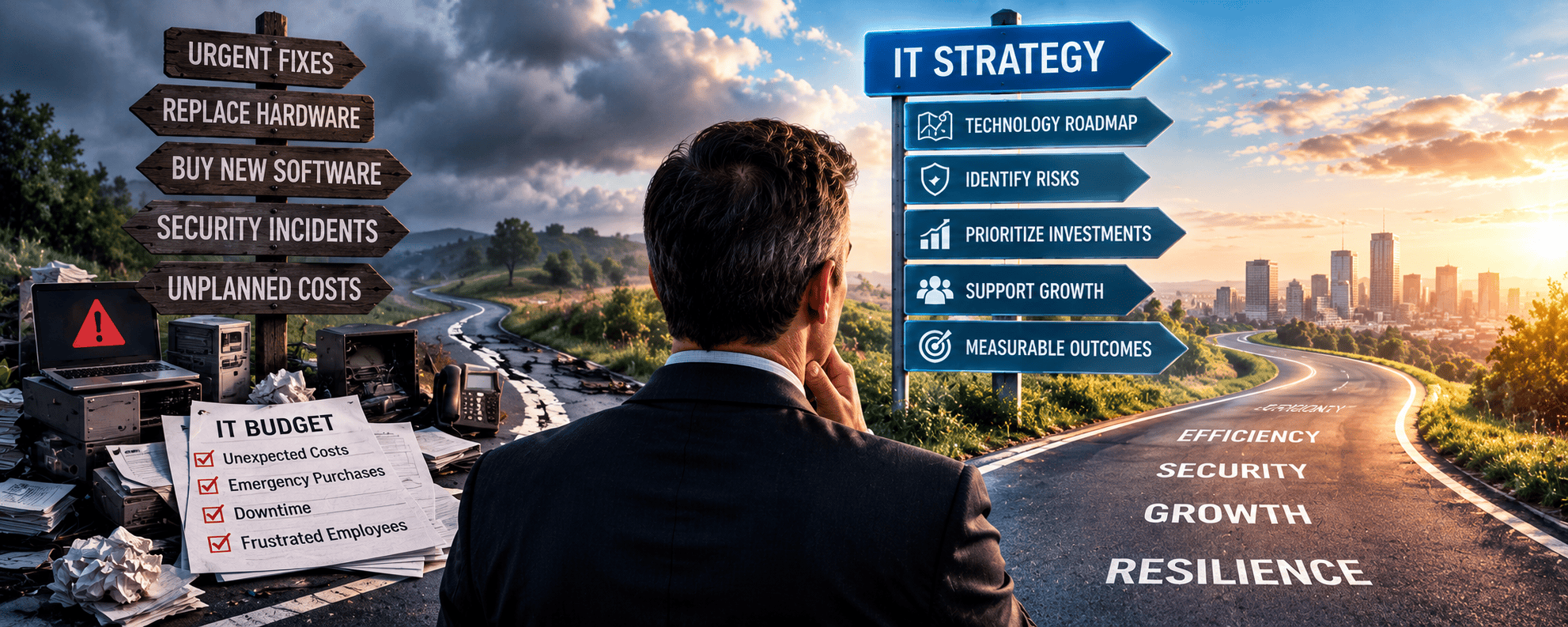
Your business probably has an IT budget.
You know what you spend on computers, software, Microsoft 365, cybersecurity, cloud services, and technical support.
You might even have a spreadsheet tracking every subscription and renewal.
Congratulations. You know what technology costs.
But do you know what it’s supposed to accomplish?
That’s where things get interesting. Many businesses have a technology budget but no real technology strategy.
- They replace computers when they break.
- Upgrade software when vendors require it.
- Add cybersecurity tools when something scary happens.
- Invest in cloud services because someone says it’s time to move to the cloud.
Suddenly, technology decisions are made one problem, one invoice, and one emergency at a time.
The result? A growing IT budget that doesn’t necessarily translate into a stronger, more productive, or more resilient business.
An IT budget tells you what you’re spending. An IT strategy tells you why you’re spending it.
And that difference matters more than most business leaders realize.
Spending Money on IT Isn’t the Same as Investing in Your Business
Think about how your organization makes technology decisions.
- Does a server get replaced because it’s failing?
- Does your cybersecurity budget increase after an attempted breach?
- Do employees receive new computers only when the old ones become painfully slow?
- Does a new software subscription get approved because a department insists it needs another tool?
None of these decisions are necessarily wrong.
But when they’re made independently, without considering broader business objectives, they can create an expensive collection of disconnected technology investments.
You might end up with overlapping applications, aging infrastructure, inconsistent security controls, and systems that don’t work particularly well together.
We’ve discussed this in Stop Buying Technology. Start Investing in Business Outcomes.
The objective shouldn’t be to purchase more technology. It should be to make technology support measurable business outcomes.
That might mean improving employee productivity, reducing operational downtime, strengthening cybersecurity, supporting expansion, or creating more predictable operating costs.
Technology should help the business move forward. Not simply to consume a larger portion of the budget every year.
Your Technology Roadmap Shouldn’t Be a Shopping List
A technology roadmap is one of the most useful tools a business can develop.
And no, it doesn’t have to be a 50-page document filled with technical terminology that nobody outside the IT department understands.
A practical roadmap identifies where your technology stands today, where the business needs to go, and which improvements should happen along the way.
It should account for:
- Hardware lifecycle: When will servers, workstations, and network equipment need replacement?
- Cybersecurity: Which risks need attention, and which safeguards should take priority?
- Cloud infrastructure: Are current hosting and cloud solutions still appropriate for the business?
- Business continuity: Can critical systems be restored within acceptable timeframes?
- Software and licensing: Are existing applications delivering value, or creating unnecessary costs?
- Growth and scalability: Will current technology support additional employees, locations, or services?
- AI readiness: Is the organization prepared to adopt AI securely and effectively?
A useful roadmap also assigns approximate costs, priorities, responsibilities, and timelines.
For example, a business might discover that its aging server needs replacement within 12 months, its Microsoft 365 security configuration requires immediate attention, and its communications system should be modernized before opening another location.
Those investments shouldn’t all compete for attention at once. A roadmap helps leadership understand what comes first, what can wait, and why.
Not Every IT Problem Deserves the Same Priority
Here’s another common challenge. The loudest technology problem often gets the most attention.
An executive’s laptop is slow. A department wants new software. Someone complains about Wi-Fi. A vendor announces a new feature.
Meanwhile, a critical server is approaching end of life, backups haven’t been tested, and former employees may still have access to business systems.
Guess which issues are more likely to create serious business problems?
Strategic IT planning requires prioritizing investment based on business impact, not whoever complains the loudest.
The NIST Cybersecurity Framework 2.0 Small Business Quick-Start Guide encourages organizations to identify important assets, understand cybersecurity risks, and make informed decisions about protecting business operations.
This principle extends beyond cybersecurity. Before approving a technology investment, leadership should ask:
- What business problems are we solving?
- What happens if we delay this investment?
- Does it reduce risk, improve efficiency, or support growth?
- Are there existing tools or resources we could use more effectively?
- How will we measure whether the investment worked?
These questions turn technology purchasing into business decision-making. They can also prevent a surprising amount of unnecessary spending.
The Hidden Cost of Not Planning Ahead
Reactive technology spending tends to get expensive.
Consider a company that postpones replacing an aging server to save money. On paper, that looks like a reasonable budget decision.
Until the server fails.
Now employees can’t access critical applications. Business operations are interrupted. Emergency replacement equipment is needed. Technical teams are working overtime to restore services.
The company still has to replace the server.
Now it’s paying for downtime, emergency labor, and operational disruption, too.
The same pattern applies to unsupported software, aging network equipment, neglected cybersecurity, and poorly managed cloud environments.
The Center for Internet Security’s CIS Controls emphasize foundational practices such as maintaining inventories of enterprise assets and software.
Knowing what technology you have, its condition, and when it needs attention is fundamental to making informed investment decisions.
A proactive strategy helps businesses anticipate expenses rather than constantly react to them.
It doesn’t eliminate unexpected problems. But it can reduce the number of surprises that become emergencies.
Your IT Budget Should Reflect Your Business Goals
Technology priorities should change as business priorities change.
If you’re planning to hire 20 employees, your infrastructure, licensing, devices, and security requirements may need to expand.
Or maybe you’re opening another office; connectivity, communications, and remote access become important considerations.
If you’re acquiring another company, you may need to address system integration, cybersecurity, and data management before the transaction is complete.
If you’re introducing AI, you need to evaluate data quality, permissions, infrastructure, and governance before investing heavily in new tools.
And if your goal is to control costs, you should understand which technology investments actually create value.
This is why strategic IT planning needs input from business leadership. IT decisions shouldn’t happen in isolation from financial planning, operations, staffing, or growth objectives.
NIST’s Enterprise Risk Management Quick-Start Guide reinforces the importance of integrating technology-related cybersecurity risk into broader organizational decision-making.
The same business-first thinking should guide your technology roadmap.
Your IT strategy should follow your business strategy, not the other way around.
You Don’t Need a Full-Time CIO to Think Like One
Large organizations often employ a Chief Information Officer to oversee technology strategy, investment planning, governance, and long-term priorities.
Smaller businesses rarely have that luxury.
Technology decisions often fall to the owner, CFO, operations manager, or an internal IT employee who is already busy keeping everything running.
And while those individuals may be excellent at their jobs, strategic technology planning requires time, expertise, and perspective.
That’s where a Fractional CIO, sometimes called a virtual CIO or vCIO, can provide value.
Rather than hiring a full-time executive, businesses can access strategic IT leadership to help with:
- Developing technology roadmaps aligned with business objectives.
- Evaluating infrastructure and cybersecurity risks.
- Planning hardware replacements and software investments.
- Forecasting technology costs and managing vendor relationships.
- Prioritizing projects based on operational and financial impact.
- Preparing for growth, acquisitions, or organizational changes.
- Reviewing progress and adjusting priorities as business needs evolve.
This strategic oversight complements day-to-day technical support and infrastructure management.
Through Managed IT Services, a trusted IT partner helps businesses take a more proactive approach to technology management, maintenance, and planning.
The goal isn’t simply to keep computers working. It’s to make sure the technology environment supports where the business is headed.
Questions Every Business Leader Should Ask About IT Strategy
If you’re responsible for managing a business, you don’t need to know every technical detail of your network.
But you should be able to get clear answers to these questions.
Do we have a documented technology roadmap?
Can someone explain what technology improvements are planned over the next 12 to 24 months, why they’re necessary, and what they’ll cost?
Are we prioritizing investments based on business risk?
Do we understand which systems are most critical and which weaknesses could create the greatest operational or financial impact?
Are we getting value from the technology we already own?
Are there unused licenses, overlapping applications, underutilized features, or opportunities to improve employee productivity?
Is our technology prepared for where the business is going?
Will our current infrastructure, cybersecurity, cloud services, and communications support planned growth and operational changes?
Who is accountable for our long-term IT strategy?
Is someone actively evaluating technology investments, coordinating vendors, managing priorities, and reporting to leadership?
If these questions are difficult to answer, your business may have an IT budget without a meaningful IT strategy.
Stop Budgeting for Technology Problems. Start Planning for Business Outcomes.
Technology will always require investment.
- Computers need replacing.
- Software evolves.
- Cybersecurity threats change.
- Businesses grow.
The question isn’t whether you’ll spend money on IT. It’s whether those investments are planned, prioritized, and aligned with what your organization is trying to accomplish.
A good technology strategy gives leadership greater visibility into future expenses, operational risks, and opportunities for improvement.
It helps turn IT from a recurring expense into a business investment.
And it makes technology decisions less reactive, less confusing, and potentially much more valuable.
Because the most expensive IT decision isn’t always the one with the biggest price tag. Sometimes it’s the decision you never planned for.
A proactive IT partner helps businesses evaluate their technology environments, identify risks, develop priorities, and align IT investments with long-term business goals.
Whether you need ongoing Managed IT Services, strategic technology planning, or additional executive-level IT guidance, the first step is understanding where you are and where you want to go.