
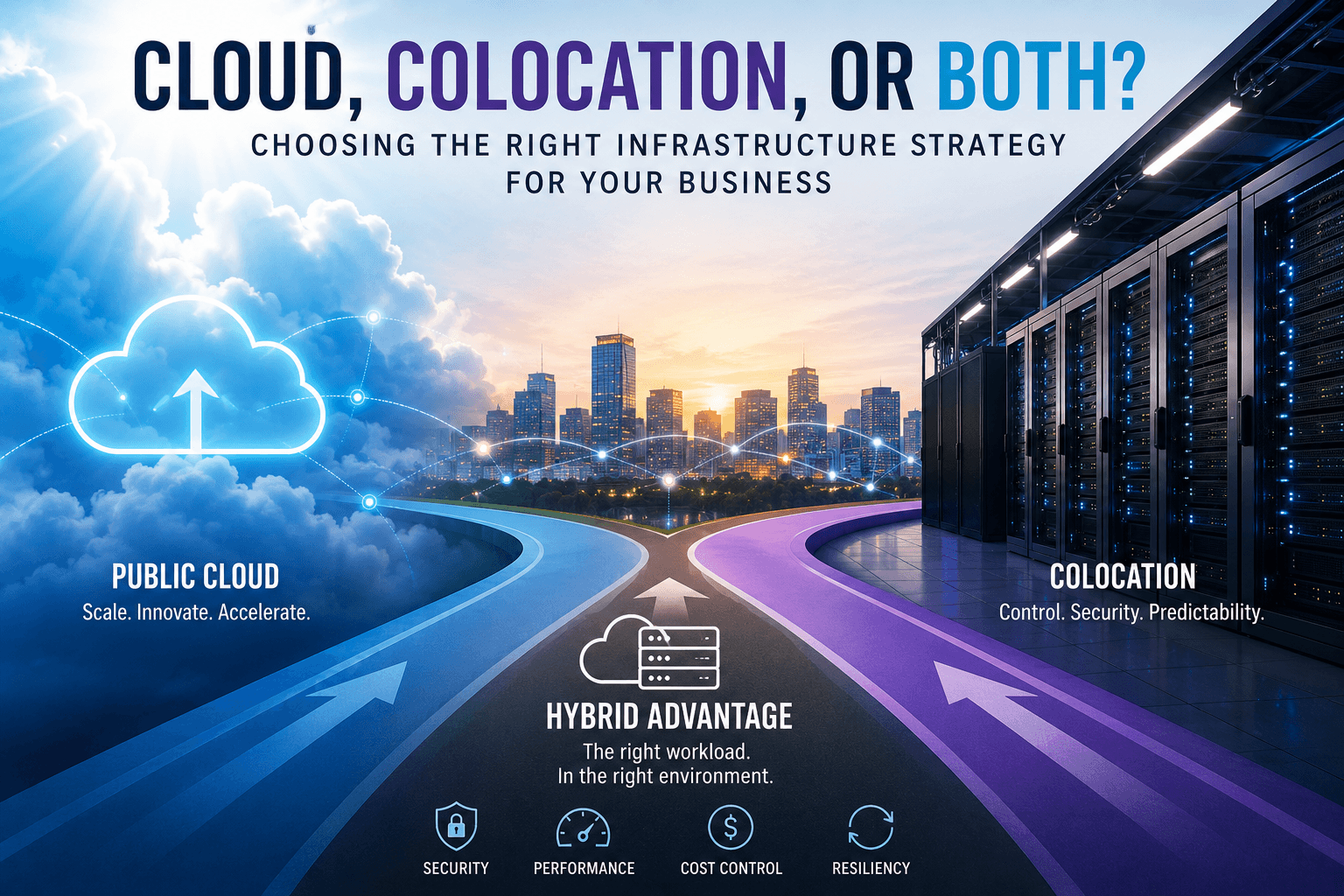
Choosing the Right Infrastructure Strategy for Your Business
For years, “move everything to the cloud” has been one of the most common recommendations in IT.
Cloud platforms like Amazon Web Services (AWS) have transformed the way organizations deploy applications, store data, and scale their infrastructure. Businesses can launch servers in minutes, expand capacity on demand, and access hundreds of cloud services without purchasing additional hardware.
For many organizations, those advantages are significant. But somewhere along the way, many businesses began treating cloud computing as the answer to every infrastructure challenge.
It’s not.
The reality is that the best infrastructure strategy isn’t always cloud-only or on-premises. Increasingly, organizations are finding that a hybrid approach, combining public cloud platforms with professionally managed colocation and private infrastructure, offers the flexibility, performance, security, and cost control they need to support modern business operations.
We help organizations evaluate technology based on business objectives rather than industry trends. Sometimes that means migrating workloads to the cloud. Other times, it means placing critical systems in a secure, professionally managed data center.
More often than not, it means finding the right balance between the two.
The goal isn’t simply to move infrastructure. The goal is to build an environment that supports growth, protects critical data, and gives your business the flexibility to adapt as technology continues to evolve.
Cloud Computing Has Changed Business
There’s no question that public cloud platforms have fundamentally changed enterprise IT.
The AWS Cloud Computing Overview states that organizations can deploy infrastructure globally within minutes while leveraging services ranging from virtual servers and storage to databases, artificial intelligence, analytics, and application development.
Instead of purchasing physical servers months before they’re needed, businesses can provision computing resources on demand and pay only for what they consume.
That flexibility has accelerated innovation across virtually every industry.
Organizations use AWS to:
- Host customer-facing applications
- Build disaster recovery environments
- Support software development and testing
- Analyze business data
- Deploy AI and machine learning solutions
- Scale seasonal workloads
- Expand into new geographic markets
For startups and rapidly growing companies, the ability to increase capacity without purchasing hardware can significantly reduce time to market.
Cloud computing has earned its place as an essential part of modern IT.
But cloud isn’t automatically the right answer for every workload.
The Hidden Costs of “Cloud First”
One of the biggest misconceptions surrounding public cloud is that it’s always less expensive than owning or colocating infrastructure.
Sometimes it is. Sometimes it isn’t.
Public cloud pricing works exceptionally well for applications with unpredictable demand or workloads that scale up and down throughout the day.
However, businesses running stable, always-on systems often discover that monthly cloud costs continue to grow over time.
- Storage expands
- Backups increase
- Additional services are enabled
- Data moves between cloud environments
- Users generate more traffic
- Applications consume additional resources
Before long, the monthly bill begins looking very different from the original estimate.
Amazon itself encourages organizations to continuously review resource utilization and optimize costs through its AWS Well-Architected Framework, recognizing that cloud environments require ongoing management to remain efficient.
Cloud economics are dynamic.
Without active monitoring and governance, organizations frequently pay for resources they no longer use or provision more capacity than they actually need.
That’s why successful cloud adoption isn’t just about migration. It’s about continuous optimization.
Where Colocation Still Makes Sense
Public cloud has changed the industry. It hasn’t eliminated the need for data centers.
In fact, professionally managed colocation continues to play a critical role for organizations that require predictable performance, consistent operating costs, regulatory compliance, or specialized hardware.
Rather than housing servers in an office closet, colocation allows businesses to place their equipment in a secure, professionally managed facility with redundant power, cooling, internet connectivity, and physical security.
That provides many of the benefits of enterprise infrastructure without the cost of building and maintaining a private data center.
Organizations frequently choose colocation for:
- Business-critical applications
- Large databases
- File storage
- Backup repositories
- Specialized hardware
- High-performance computing
- Legacy business applications
- Regulatory or compliance requirements
For workloads that run 24 hours a day, seven days a week, colocation often delivers more predictable long-term costs than consumption-based cloud pricing.
It also gives organizations complete control over their infrastructure while reducing the operational burden of maintaining facilities internally.
Learn more about Cloud Solutions and Data Center Services.
Performance Still Matters
As businesses adopt AI, cloud collaboration, VoIP, and real-time analytics, infrastructure performance becomes increasingly important.
Latency affects far more than website speed. It influences:
- Voice quality during business calls
- Microsoft Teams meetings
- Database performance
- AI response times
- Customer experience
- Application responsiveness
- File synchronization
- Remote desktop performance
Applications that depend on low latency often benefit from infrastructure located closer to users or integrated directly with private networking environments.
In some cases, public cloud delivers excellent performance. In others, colocated infrastructure provides greater consistency and control.
Rather than assuming one platform is inherently better, organizations should evaluate where each workload performs best.
That’s the difference between following technology trends and building an infrastructure strategy aligned with business outcomes.
Are you looking for colocation services? We can help.