
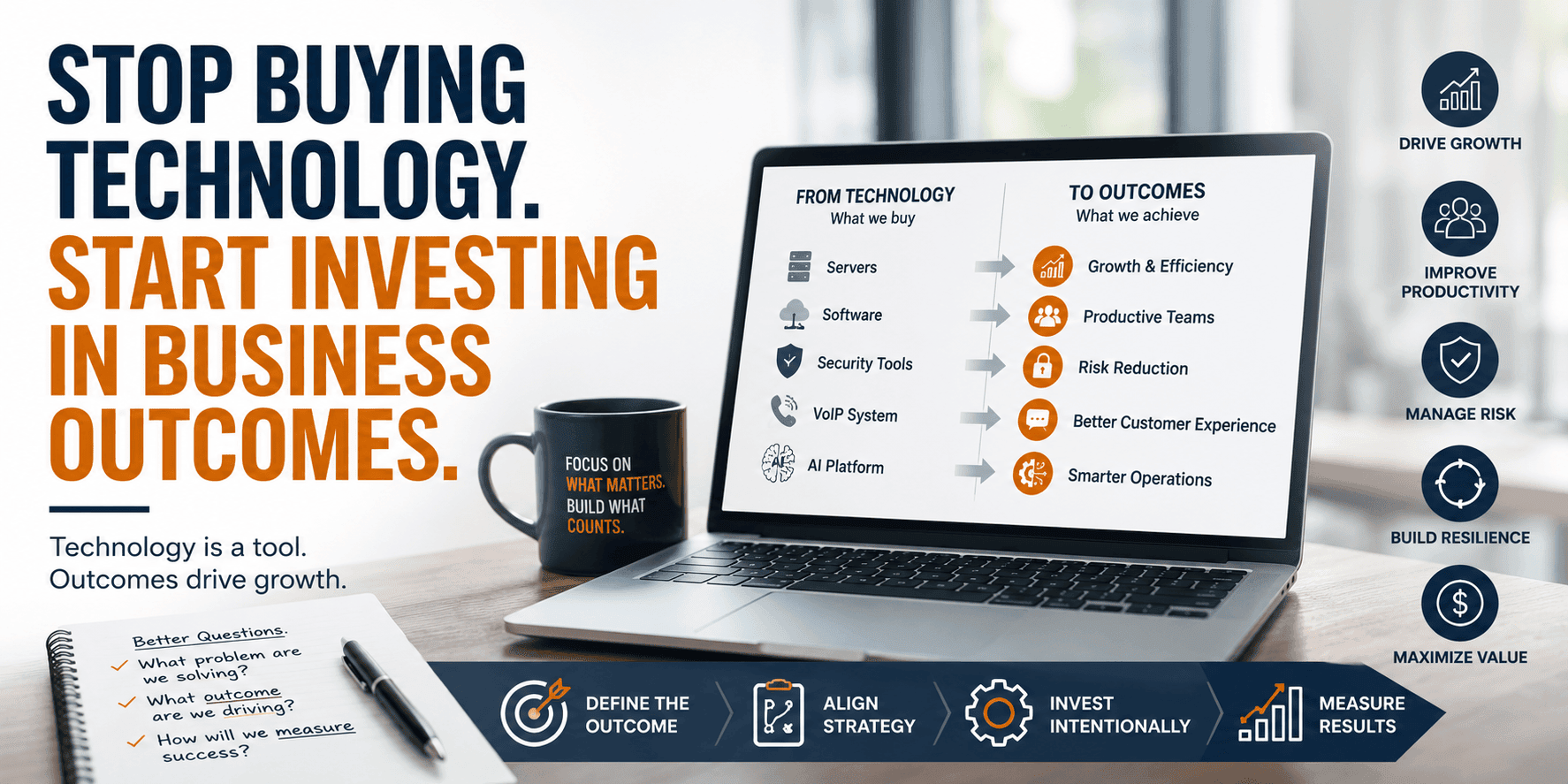
I’ve never heard a CEO say, “I wish we’d bought more servers.”
I’ve heard plenty say they wish their employees were more productive, customers received faster service, systems went down less often, or the business had been better prepared when something went wrong.
That’s an important distinction because businesses don’t really need technology.
They need what technology makes possible.
Yet many organizations still make technology decisions backward. They start with a product, platform, feature list, or price and then try to figure out how it fits the business.
Maybe it’s time we stopped buying technology and started investing in outcomes.
Nobody Wants a Firewall
Think about it. Nobody wakes up in the morning excited because their company has a new firewall.
What they want is to protect customer information, reduce the likelihood of a breach, satisfy insurance requirements, keep the business operating, and avoid getting the phone call nobody wants at 2:00 in the morning.
The firewall is simply one of the tools that help produce those outcomes.
The same thing is true across your technology environment; you need these things:
- Backup software. But you want to recover your business when something goes wrong.
- Microsoft 365. Still, you want employees to communicate, collaborate, and work efficiently.
- Cybersecurity tools. Yet, you still need to reduce business risk.
- Cloud infrastructure. And you need reliability, scalability, and flexibility.
- AI. But it’s a tool and you want employees to accomplish more without adding unnecessary repetitive work.
- VoIP platform. And you want customers to reach the right person quickly and have a better experience.
Once you look at technology this way, the conversation changes.
Instead of asking, “What should we buy?”
You start asking, “What are we trying to accomplish?”
That’s a much better place to start.
Start With the Business Problem
Let’s say an employee tells you their computer is slow. The obvious answer is to replace the computer.
But what if the actual problem is that your entire sales team is losing 30 minutes a day waiting for applications to load, searching for information, switching between disconnected systems, and dealing with aging hardware?
Now we’re solving a different problem.
- The objective isn’t to buy 10 computers.
- The objective is to give the sales team back productive time.
That may involve replacing hardware, but it could also involve improving the network, consolidating applications, cleaning up Microsoft 365, automating workflows, or changing how information is stored.
Microsoft makes a similar point in its guidance for small and midsized businesses: digital transformation should begin with a long-term strategy centered on clear, measurable business outcomes, rather than technology for technology’s sake.
That’s the difference between buying IT and developing an IT strategy.
Cheap Technology Can Get Expensive Fast
Price matters. Every business has a budget, and throwing money at technology isn’t a strategy either.
But the lowest purchase price doesn’t necessarily produce the lowest business cost.
We talked about this recently in our article on the hidden risks of aging technology. A computer can technically still work while quietly costing the organization through slower workflows, additional support, downtime, security limitations, and employee frustration.
Microsoft reported similar issues in research around aging devices and AI-ready PCs, noting that older hardware can contribute to slower workflows and greater IT support overhead.
A Forrester study commissioned by Microsoft also modeled potential returns from hardware modernization through a combination of productivity, IT efficiency, and security improvements. Those figures shouldn’t be treated as a guaranteed return for every business, but they illustrate why purchase price alone is an incomplete measure of technology value.
The better question is:
“What does this technology cost us over its useful life, and what business value does it create during that time?”
That’s a very different calculation.
Cybersecurity Is a Business Outcome, Too
Cybersecurity is another area where this distinction becomes especially important.
It’s easy to turn cybersecurity into a shopping list.
- MFA? Check.
- EDR? Check.
- Firewall? Check.
- Backup? Check.
- Security awareness training? Check.
But having security products doesn’t automatically mean you have a secure business.
Our approach to Cybersecurity Services looks at security in the context of business continuity, customer trust, compliance, cyber insurance, operational resilience, and financial performance. The tools matter, but they’re there to support those larger outcomes.
This is also how NIST approaches cybersecurity. The current NIST Cybersecurity Framework 2.0 is explicitly organized around cybersecurity outcomes rather than prescribing one specific set of technologies.
NIST also says organizations can use the framework to prioritize cybersecurity according to business requirements, resources, and risk tolerance.
That’s a business conversation. Not a firewall conversation.
Your Backup Is Worth Nothing Until You Need It
Backups provide another great example.
You could compare two backup solutions by storage capacity, licensing cost, retention periods, encryption, and a dozen other specifications.
Those things matter. But there’s one question that matters more:
How quickly can we get the business running again?
We’ve written about this in Why “We Use Microsoft” Is Not a Backup Strategy. Availability and recoverability aren’t the same thing. A real backup strategy needs to consider how much data the business can afford to lose and how quickly critical operations need to be restored.
That’s why effective Remote Backup Solutions are designed around recovery and business continuity rather than simply providing another place to store files.
- You’re not buying backup storage.
- You’re buying the ability to recover.
Just look at this post we wrote about PocketOS.
The Cloud Isn’t the Strategy Either
The same thinking applies to the cloud.
I’ve seen businesses approach cloud adoption as if simply moving something “to the cloud” automatically makes it better.
It doesn’t.
Sometimes the cloud is absolutely the right answer. Sometimes colocation makes more sense. Increasingly, the right answer is a hybrid combination built around the organization’s workloads, security requirements, budget, and growth plans.
Cloud Solutions include IaaS, colocation, remote backup, hosting, and business continuity options because different workloads require different approaches.
Solutions like our xCloud IaaS platform, for example, support public, private, and hybrid cloud environments rather than assuming one architecture works for everyone.
The question shouldn’t be:
“Should we move to the cloud?”
It should be:
“What infrastructure gives us the right combination of performance, security, resilience, flexibility, and cost?”
Now we’re talking about outcomes again.
AI Makes This Even More Important
Artificial intelligence may be the best current example of technology-first buying.
Everybody is talking about AI, so naturally businesses are asking which AI products they should purchase.
I’d reverse the question.
“What repetitive work are you trying to eliminate?”
Maybe your employees spend hours summarizing meetings. Perhaps your receptionist answers the same questions 30 times a day, salespeople spend too much time updating your CRM, or managers struggle to find information buried inside Microsoft 365.
Those are business problems.
AI may be a fantastic solution but buying AI because everyone else is buying AI is no more strategic than buying servers because servers happen to be on sale.
As we’ve discussed in our recent AI content, the objective is not to deploy the most AI. It’s to use AI where it can meaningfully improve productivity, customer experience, decision-making, and business processes.
Think Before Your Next Tech Purchase
Before approving your next major technology purchase, try changing the questions you ask.
Instead of beginning with specifications and price, ask:
- What business problem are we trying to solve?
- How will we know if the investment worked?
- Will it save employees meaningful time?
- Will it improve customer experience?
- Does it reduce business risk?
- Does it make us more resilient?
- Can it scale with the organization?
- Does it eliminate another cost or unnecessary system?
- How does it fit with our three-year technology strategy?
- What happens if we do nothing?
That last question is particularly important.
Doing nothing has a cost, too.
What Smart IT Looks Like in the Real World
Imagine two companies with the same $100,000 technology budget.
Company A Is Tech Product First
Company A starts with products. It replaces some computers, renews a collection of software subscriptions, buys another security tool, upgrades a server, and adds an AI application because leadership has been hearing a lot about AI.
At the end of the year, it spent $100,000 on technology.
Company B Is Outcome First
Company B starts with outcomes. Leadership decides it wants to reduce downtime, improve sales productivity, strengthen cybersecurity, shorten recovery time, and eliminate repetitive administrative work.
It may ultimately buy some of the exact same technology as Company A.
But there’s an important difference. Every investment has a reason.
And every reason can be measured against a business result.
This Is Why IT Strategy Matters
As businesses grow, technology decisions become interconnected.
- Replacing a server affects cloud strategy.
- Adopting AI affects security and data governance.
- Hiring remote employees affects identity, endpoint management, communications, and cybersecurity.
- Changing your CRM may affect phones, marketing, customer service, reporting, and Microsoft 365.
You can’t make those decisions effectively in isolation.
That’s why you should approach Managed IT Services as part of a broader business strategy. The goal is to understand where the organization is going and then build the technology environment required to support it.
That changes IT from:
“What broke today?”
to:
“Where is the business going next?”
That’s the conversation leadership should be having.
Technology Has Never Been the Goal
I like technology. Think about that for a second, really spend some time thinking about the FACT that technology is not the goal. What is the goal?
I’ve spent a good portion of my career working around it, talking about it, marketing it, and helping businesses understand it.
But technology by itself isn’t particularly valuable.
What matters is what happens after you implement it.
- Do employees get more done?
- Are customers happier?
- Can the company recover faster?
- Is your data safer?
- Can you grow without rebuilding everything?
- Are you spending less time reacting to problems?
Those are the outcomes worth investing in.
So, the next time someone walks into your office and says, “We need to buy…”, stop them before they finish the sentence.
Ask one question:
“What business problem are we trying to solve?”
You may still end up buying the technology. But now you’ll know why.
Build an IT Strategy Around Your Business
This is the biggest mistake most businesses make.
If technology decisions at your organization are driven primarily by broken equipment, renewal dates, vendor recommendations, or whatever problem happens to be loudest this week, it may be time to change the conversation.
Organizations need to align managed IT, cybersecurity, cloud infrastructure, Microsoft 365, communications, AI, and business continuity around the outcomes leadership actually cares about. The objective isn’t more technology. It’s a technology strategy that protects the business, empowers employees, and supports long-term growth.