
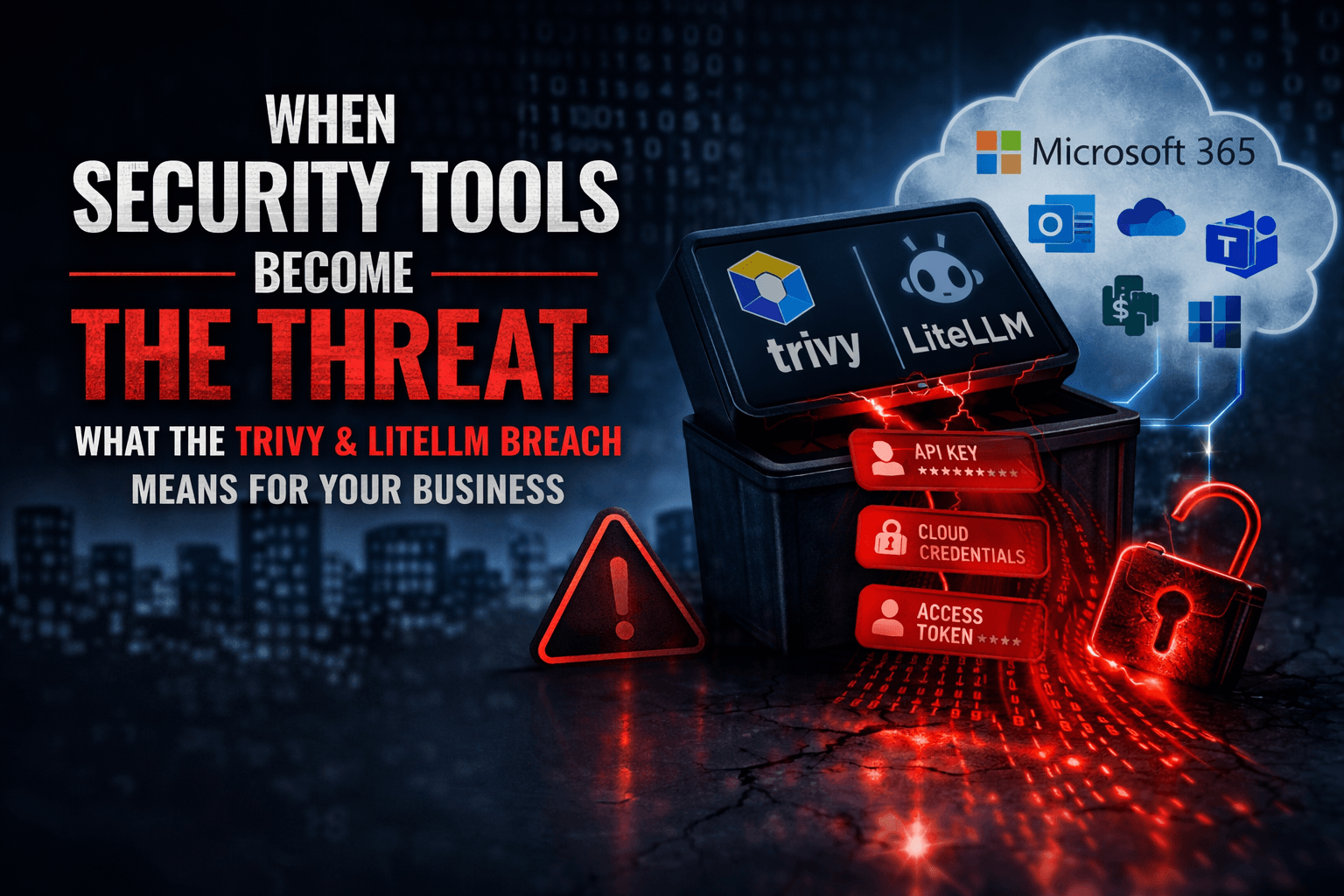
What the Trivy & LiteLLM Breach Means for Your Business
You trust your technology…
- Your security tools.
- Your cloud platforms.
- And the software running your business every day
But what if that trust is exactly what attackers are counting on?
In March 2026, a major supply chain attack, reported by The Register, proved something critical:
Even trusted security tools can be turned against you. And if that can happen, what does it mean for your business?
When Protection Becomes Exposure
A widely used vulnerability scanner, Trivy, was compromised as part of a supply chain attack that inserted malicious code into legitimate releases.
Security researchers, including Microsoft Security, have increasingly warned that software supply chains are becoming a primary attack surface.
That code appeared normal but was designed to quietly harvest credentials and sensitive data, giving attackers access without triggering obvious alarms.
The breach didn’t stop there. It extended into LiteLLM, a popular AI integration library, spreading through trusted software distribution channels used by developers and organizations worldwide.
Further analysis from Datadog Security Labs confirmed that compromised packages were capable of exfiltrating cloud credentials and developer secrets at scale. There are no…
- Phishing emails
- Suspicious downloads
- Obvious red flags
Just trusted tools… doing exactly what they were supposed to do, while secretly leaking access.
Threats Are Invisible, Trusted, and Already Inside
This is what modern cyber threats look like:
- They don’t break in, they log in
- They don’t exploit weaknesses, they exploit trust
- And they don’t disrupt immediately, they observe, collect, and expand
This aligns with broader industry guidance around , as outlined by the National Institute of Standards and Technology, where trust is never assumed, only continuously verified.
By the time anything looks wrong, access has already been established.
And in today’s cloud-first environments, especially platforms like Microsoft 365, that access often means:
- Email systems
- File storage
- Identity systems
- Business-critical applications
Why This Matters to Your Business
You don’t need to use Trivy or LiteLLM to be affected by this kind of risk.
Because your business relies on the same model: Third-party software + cloud access + integrated systems
That includes:
Every one of these introduces convenience, and dependency. And dependency without visibility creates risk.
How to Strengthen Your IT and Security Posture
The issue isn’t just the tools you use. It’s how those tools are managed, monitored, and validated over time.
Most organizations don’t have a technology problem. They have a visibility and control problem.
This is why modern managed security frameworks emphasize continuous monitoring and response, often delivered through managed services models similar to those defined by Managed Security Service Providers (MSSP).
What Needs to Change in Your IT Infrastructure
To protect your business in today’s landscape, five things must be true:
Identity Must Be Secured
If attackers gain credentials, they gain access.
- Multi-factor authentication (MFA)
- Conditional access policies
- Least-privilege access
You Need Real Visibility into Your IT Infrastructure
If something changes, you need to know.
- Monitoring across systems
- Behavioral alerting
- Log visibility
Your Tools Must Be Managed, Not Assumed Safe
Even trusted tools can become compromised.
- Version control and validation
- Update oversight
- Vendor awareness
Backup Must Be Independent and Tested
If something goes wrong, recovery matters more than prevention.
- Verified backups
- Recovery testing
- Separation from production environments
IT Must Be Proactive, Not Reactive
Security is not a one-time setup. It’s continuous.
The Cybersecurity Reality Check
This attack didn’t succeed because businesses were careless.
It succeeded because:
- Technology is more interconnected than ever
- Trust is built into modern systems
- Threats are evolving faster than most organizations can keep up
The question isn’t whether your tools are secure. The question is whether you’d know if they weren’t.
Are you ready to take these threats seriously? We can help!