
Every week, it seems like there’s another headline promising that Agentic AI is going to revolutionize business.
- AI employees.
- Autonomous workflows.
- Digital coworkers.
- Entire departments running themselves.
It’s exciting, and if we’re being honest, it’s also a little intimidating.
Whenever a technology creates this much excitement, it’s tempting to ask:
“How quickly can we implement Agentic AI?”
I think that’s the wrong question.
The better question is:
“Are we actually ready for Agentic AI?”
That’s a much less exciting headline, but it’s the conversation more businesses need to have.
Over the past year, I’ve talked with business owners who are eager to explore AI. Some want AI to answer phones, others want it to automate customer service, summarize meetings, build proposals, or help employees work more efficiently. Those are all worthwhile goals.
But here’s what I’ve noticed.
Most organizations don’t have an AI problem.
They have a data problem. Or they have:
- An identity problem.
- A governance problem.
- An infrastructure problem that’s been hiding in plain sight for years.
Agentic AI doesn’t magically solve those issues. In many cases, it simply helps them happen faster.
That doesn’t mean businesses should avoid agentic AI. Far from it.
I believe agentic AI will fundamentally change how organizations operate over the next several years. Businesses that embrace it thoughtfully will gain real advantages in productivity, customer service, and operational efficiency.
The keyword is thoughtfully.
We’ve always believed that technology should support business goals, not distract from them.
Agentic AI should be no different.
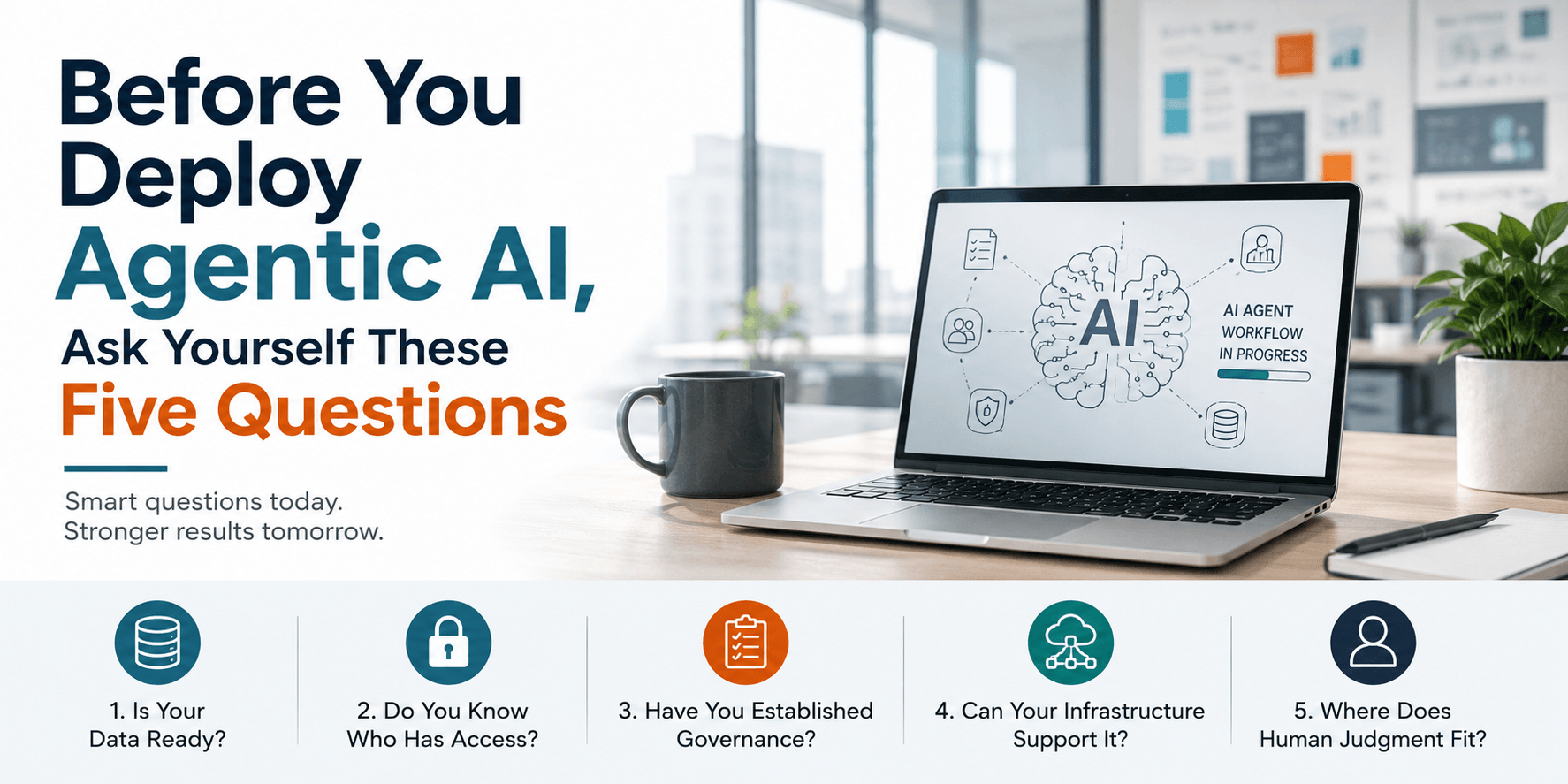
So, before you deploy your first AI agent, I think there are five questions every business should answer.
- Is your data ready?
- Do you know who has access?
- Have you established good AI governance?
- Can your infrastructure support Agentic AI?
- Where does human judgment fit?
Let’s dive into each of these…
1. Is Your Data Ready?
Imagine hiring the smartest employee you’ve ever met.
Now imagine giving them access to filing cabinets full of outdated documents, duplicate spreadsheets, incomplete customer records, and folders that nobody has organized in years.
How successful do you think they’ll be?
That’s essentially what happens when organizations deploy AI without preparing their data.
Agentic AI doesn’t create knowledge. It works with the knowledge you already have.
If your customer information lives in three different systems, your SharePoint permissions haven’t been reviewed in years, and your employees save files wherever they happen to remember, AI won’t fix those problems.
It will simply work with inconsistent information faster than a human could.
Microsoft has emphasized this point repeatedly as organizations adopt Microsoft 365 Copilot. AI performs best when organizations have well-managed data, appropriate permissions, and a solid information architecture.
Before introducing agentic AI into your organization, ask yourself:
- Can employees easily find accurate information?
- Are duplicate files creating confusion?
- Are Microsoft 365 permissions current?
- Do people have access to information they shouldn’t?
- Is customer information consistent across systems?
These questions aren’t really about AI. They’re about building a healthier technology environment.
2. Do You Know Who Has Access?
For years, cybersecurity professionals have been saying that identity is the new perimeter.
AI makes that statement even more important. Traditional applications generally wait for employees to do something.
Agentic AI is different.
It can retrieve information, analyze documents, generate content, complete tasks, and interact with multiple business systems on behalf of users.
That creates tremendous opportunities. It also creates tremendous responsibility.
If an AI agent can access your CRM, Microsoft 365 environment, accounting platform, and customer database, its permissions matter just as much as those of the employee using it.
That’s why identity management should be one of the first conversations organizations have before deploying agentic AI.
Do you know:
- Who has administrative access?
- Which service accounts still exist?
- Whether former employees still have active permissions?
- Which applications can access sensitive information?
- Is Multi-Factor Authentication (MFA) enabled everywhere it should be?
Strong identity management has always been important.
AI simply raises the stakes.
That’s one reason businesses continue investing in Cybersecurity Services alongside AI initiatives. Identity protection, endpoint security, logging, and continuous monitoring become even more valuable when intelligent systems begin interacting with business data.
The National Institute of Standards and Technology (NIST) also emphasizes governance, access control, and continuous risk management throughout the AI lifecycle in its AI Risk Management Framework.
Notice that NIST doesn’t suggest avoiding AI.
Instead, it encourages organizations to build trustworthy AI systems supported by governance and oversight.
I think that’s exactly the right mindset.
3. Have You Established Good AI Governance Before You Need It?
Let’s be honest. Your employees probably aren’t waiting for executive approval before experimenting with AI.
- Some are already using ChatGPT to draft emails.
- Others are asking Microsoft Copilot to summarize Teams meetings.
- Marketing may be using Claude to refine website content.
- Sales might be using AI to prepare for customer calls.
None of that surprises me anymore.
In fact, I’d be more surprised if your employees weren’t experimenting with AI.
The challenge isn’t stopping them. The challenge is helping them use AI responsibly.
Good Governance Doesn’t Slow People Down. It Gives Them Confidence.
Whenever businesses hear the word governance, they often imagine thick policy manuals, complicated approval processes, and more bureaucracy.
That isn’t what good AI governance looks like.
Good governance should make it easier for employees to use AI because everyone understands the rules. It removes uncertainty by answering practical questions before they become security incidents or compliance problems.
For example:
- Which AI platforms has the company approved?
- When should employees use Microsoft Copilot instead of ChatGPT or Claude?
- What company information should never be entered into a public AI platform?
- Should AI-generated content be reviewed before it’s sent to customers?
- Who is responsible for verifying accuracy?
- What business processes require human approval before AI takes action?
Those aren’t technical questions. They’re leadership questions.
They’re the same types of conversations businesses have whenever they adopt a new CRM, accounting system, or cloud platform. AI deserves the same level of planning because it will quickly become another business system that employees rely on every day.
That’s one reason why we developed Agentic AI Management Services. We believe businesses need more than access to AI tools. They need governance, security, monitoring, and a strategy that aligns AI with business objectives.
4. Can Your Infrastructure Support Agentic AI?
One of the biggest misconceptions about AI is that it’s “just software.”
In reality, successful AI deployments depend on the health of everything around them.
Think about your own business for a moment.
If employees already struggle with slow computers, inconsistent Wi-Fi, aging servers, unreliable backups, or Microsoft 365 permissions that nobody has reviewed in years, adding AI won’t magically fix those problems.
In fact, it may expose them even faster.
Agentic AI depends on a technology ecosystem that includes:
- Reliable network infrastructure
- Secure cloud services
- Modern workstations
- Well-managed Microsoft 365 environments
- Protected identities
- Endpoint security
- Business continuity planning
- Reliable backup and recovery
In other words, AI doesn’t replace good IT. It depends on it.
That’s why organizations should think about AI alongside broader technology initiatives like Cloud Solutions, Infrastructure as a Service, Remote Backup Solutions, and Business Continuity rather than treating it as another software purchase.
One of the biggest lessons we’ve learned over the years is that businesses rarely experience technology failures because of a single issue. Problems usually happen when several small weaknesses come together at the same time.
AI simply makes those weaknesses more visible.
5. Where Does Human Judgment Fit?
Let’s clear up one of the biggest misconceptions surrounding agentic AI.
Despite what some headlines suggest, most successful business implementations are not fully autonomous.
And they shouldn’t be.
The most effective organizations are building human-in-the-loop systems where AI handles repetitive execution while people continue providing judgment, oversight, approvals, and customer relationships.
Think about the kinds of work AI excels at today. It can:
- Summarize meetings
- Draft emails
- Organize documents
- Schedule appointments
- Analyze trends
- Generate reports
- Route customer inquiries
- Update CRM records
- Prepare first drafts
That’s incredibly valuable.
- But should AI approve a contract?
- Authorize a wire transfer?
- Terminate an employee?
- Respond to a major customer complaint without review?
Most business leaders would probably answer “no.” Not because AI can’t help, but because accountability still belongs to people.
That’s an important distinction. The conversation shouldn’t be about replacing employees.
It should be about helping employees spend less time on repetitive work so they can focus on the decisions that require experience, empathy, creativity, and business judgment.
That’s also the philosophy behind a broader AI strategy. We don’t see AI as a replacement for people.
We see it as another technology that should help people do their jobs better.
Take A Pause and Use This Assessment Before Deploying Agentic AI
Before your business deploys agentic AI, take a few minutes to ask yourself these questions.
- Do you know where AI is already being used inside your organization?
- Have you established an AI usage policy?
- Are Microsoft 365 permissions accurate and up to date?
- Is your customer data organized and reliable?
- Can you identify who has access to sensitive information?
- Are employees using personal AI accounts for business work?
- Have managers been trained to review AI-generated content?
- Does your cybersecurity strategy include AI?
- Are your business processes documented well enough for AI to support them?
- Most importantly, what business problem are you actually trying to solve?
If several of those questions made you pause, you’re not alone.
Most organizations are still building a foundation that allows AI to succeed.
What This Looks Like in the Real World
Imagine two companies implementing the exact same agentic AI platform.
- The first company has clean Microsoft 365 permissions, documented business processes, modern infrastructure, strong cybersecurity, reliable backups, and leadership that has established clear AI policies.
- The second company has outdated file shares, inconsistent permissions, aging hardware, scattered customer data, and no governance around AI usage.
The technology is identical. The results won’t be.
- The first organization sees AI accelerate productivity because employees trust the information it provides and understand how to use it responsibly.
- The second organization spends months chasing inaccurate data, correcting AI-generated mistakes, and reacting to security concerns that could have been avoided.
The difference isn’t the AI. The difference is the foundation underneath it.
Technology Has Never Been the Goal
One thing I’ve learned over the years is that businesses rarely struggle because they lack technology.
More often, they struggle because technology isn’t aligned with the way people actually work. Agentic AI won’t change that.
Organizations that see the greatest success won’t necessarily have the most AI. They will:
- Have the clearest strategy.
- Understand their data.
- Secure their identities.
- Establish governance.
- Modernize their infrastructure.
And they’ll keep people involved where judgment matters most. Technology has never been the goal.
Helping people do better work has always been the goal. Agentic AI is simply the next tool helping us get there.
Ready to See If Your Business Is Prepared?
If your leadership team is exploring agentic AI, don’t start by asking which platform to buy.
Start by asking whether your organization is ready for AI.
The goal isn’t to deploy AI as quickly as possible. The goal is to deploy it confidently.
If you’d like to understand where your organization stands, schedule an Agentic AI Readiness Assessment.
We’ll evaluate your infrastructure, security, governance, Microsoft 365 environment, and business processes, then help you build a roadmap for responsible AI adoption.