
I know that sounds scary, but before you make a judgment on this, hear me out.
For a while, the conversation around AI and business phone systems was straightforward.
AI could answer the phone.
It could ask why you were calling. Route you to the right department. Screen a call. Maybe take a message.
Useful? Absolutely.
But still basically a smarter receptionist… That’s starting to change.
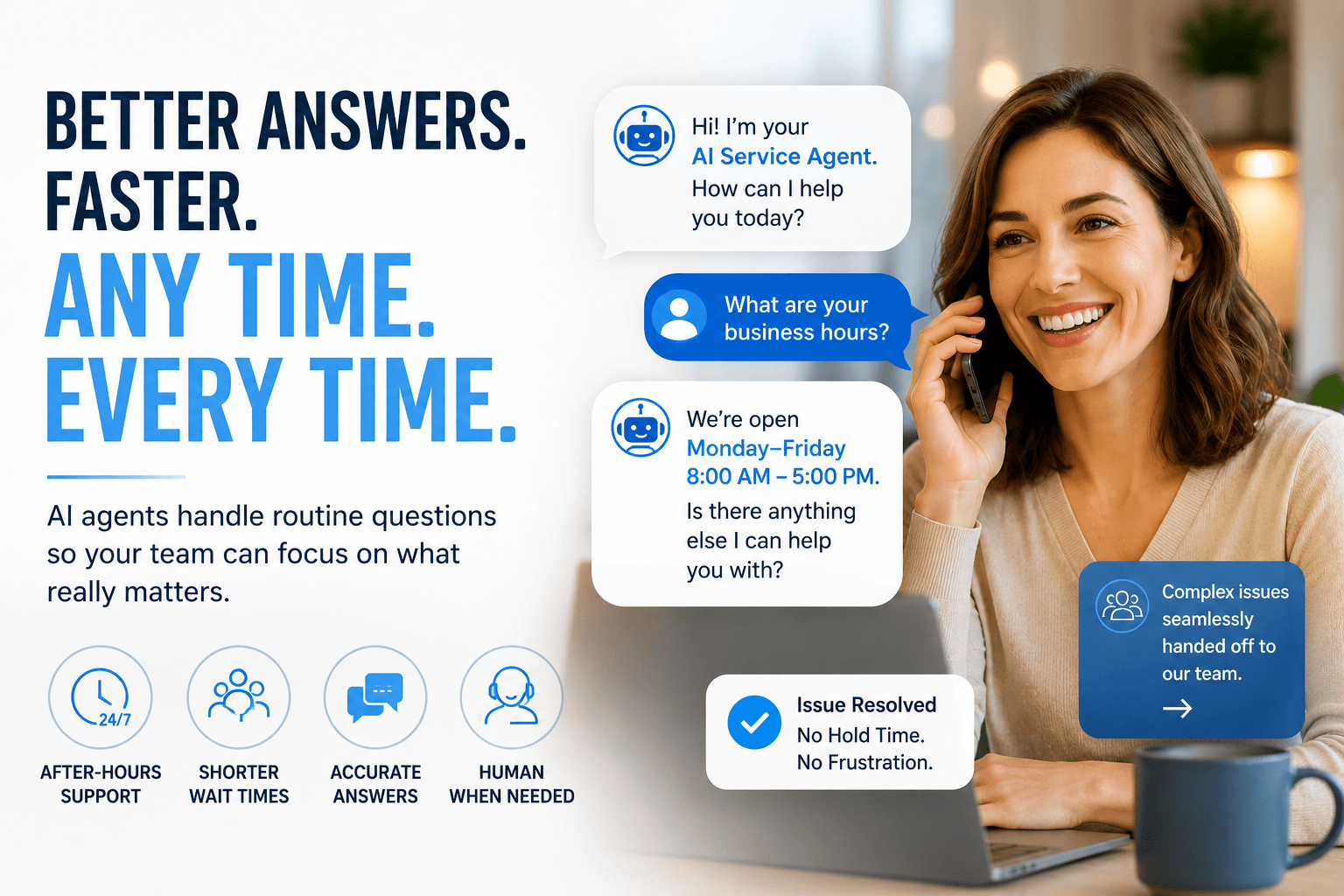
The new 3CX AI Customer Service Agent moves AI further into the actual customer service process. Instead of simply figuring out where a caller needs to go, it can listen to the problem, search approved company knowledge, provide an answer, ask follow-up questions, and determine whether a human employee needs to take over.
That’s a pretty significant shift.
The question is no longer just:
“Can AI answer our phones?”
It’s becoming:
“How many routine customer questions could AI handle before an employee ever needs to get involved?”
Think About Your Most Repetitive Customer Calls
Every business has them.
- “What time do you close?”
- “What do I need to bring to my appointment?”
- “How do I reset this?”
- “What’s your return policy?”
- “Where can I find that form?”
- “Can you tell me the status of…”
Your employees may answer variations of the same questions dozens of times every week.
None of these calls is unimportant. The customer needs an answer. But does every one require an employee?
That’s where the idea of Level 0 and Level 1 customer service becomes interesting.
Level 0 and Level 1 Customer Service
Level 0 generally refers to self-service information that doesn’t require an employee.
Level 1 is the first line of support for relatively straightforward questions and basic troubleshooting.
The new 3CX Customer Service Agent is specifically designed around these kinds of interactions.
According to 3CX’s workflow guidance, it can provide routine information, tell callers which documents they need, guide them through basic troubleshooting, gather details about an issue, and then send the caller to the appropriate person when human assistance is necessary.
That doesn’t eliminate your customer service team. It changes which calls need to reach them.
The AI Needs to Know Your Business
This is where things get more interesting than a traditional automated attendant.
A normal phone menu follows instructions:
- Press 1 for Sales.
- Press 2 for Support.
- Press 3 for Billing.
A customer service AI agent can work from company-specific information.
3CX calls these Knowledge Sources. They can include information such as:
- FAQs
- Company policies
- Product guides
- Support documentation
- Help-center articles
- Internal support notes
- Basic troubleshooting procedures
When someone asks a question, the agent can search the configured knowledge sources for relevant information and use it to respond.
That distinction matters.
You don’t want an AI customer service agent to improvise company policies or invent answers. You want it to work from information you’ve intentionally provided for that purpose.
3CX’s guidance on structuring AI Agent Knowledge Sources recommends separating information into clear topics rather than dumping huge collections of unrelated information into a single source. According to 3CX, cleaner, focused knowledge sources can improve retrieval speed and relevance.
In other words: The quality of your AI customer service depends partly on the quality of the information you give it.
That’s a governance issue as much as a technology issue.
Your Customer Service Department Doesn’t Close at 5:00 Anymore
Here’s one of the most obvious opportunities:
- A customer calls at 7:30 p.m.
- Your office is closed.
- Traditionally, that caller gets voicemail and waits until tomorrow.
But what if they’re asking something your AI agent can answer immediately?
3CX specifically identifies after-hours support as a use case for its Customer Service Agent. The AI can answer routine questions when employees aren’t available and, when necessary, hand unresolved requests back to the appropriate human destination.
That doesn’t mean your employees need to work around the clock. Quite the opposite.
It means some customers may get help without requiring an employee to be available at all.
For businesses where customer calls routinely extend beyond normal office hours, that can create a very different customer service experience. That sets you apart from competitors who do not have that option. Customers will start to wonder why everyone doesn’t have this capability.
I know the last time I was on with a support line, I certainly wondered that same thing. Think of a large company you called for support. Imagine if they had this functionality?
What Happens When Everyone Is Already Busy?
After-hours calls aren’t the only opportunity. Think about 10:30 on Monday morning when everyone is already on the phone.
A new caller enters the queue. Then another. And another.
Traditionally, they wait. Because, that’s fun… not.
3CX identifies queue overflow as another use case for the Customer Service AI Agent. When human agents are busy, AI can provide an alternative to sitting in a long queue by attempting to resolve routine requests before sending callers back to human support if needed.
That’s an important distinction. The AI isn’t simply telling customers:
“Your call is important to us. Please continue to hold.”
It’s potentially doing something useful while your employees handle the conversations that genuinely require them.
The Most Important AI Feature May Be Knowing When to Give Up
I think this is where businesses need to be particularly careful when using AI for customer service.
The goal shouldn’t be to never let the customer talk to a human. And I think that because of our experiences with bad customer service from phone auto-attendants, this is the scenario everyone immediately goes to when we describe it to them.
We’ve all experienced automated customer service systems that seem specifically designed to prevent us from reaching an actual person.
Nobody wants more of that. And that’s what we’re talking about here. We’re saying to let AI handle what AI handles well, and make it easy for a person to take over when necessary.
3CX’s AI Customer Service Agent configuration guidance includes specific controls for Human Handoff and Escalation Topics. Businesses can establish a default human destination for unresolved requests and define specific topics to route to a person, queue, or another specialized AI agent.
A human handoff can happen when:
- The AI can’t resolve the question
- The caller requests a person
- The issue requires specialized support
- A predefined topic requires human involvement
- The conversation falls outside the AI agent’s intended role
And when an employee takes over, 3CX says caller details are available in the Web Client, with the call transcript available for additional context.
That’s a much healthier way to think about AI.
AI handles the routine. People handle the exceptions.
This Isn’t About Replacing Your Customer Service Team
We’ve made this point before in our discussion about how AI won’t replace your employees.
The immediate opportunity for most businesses isn’t replacing people. It’s replacing repetitive work.
Think about an employee who answers 30 customer calls during a day.
If 10 of those are routine questions that could have been resolved automatically, you’ve potentially given that employee more time for the 20 conversations where their judgment, experience, empathy, or expertise actually matters.
That’s where the business case becomes interesting. AI customer service can potentially help organizations:
- Reduce repetitive Level 0 and Level 1 calls
- Provide useful after-hours assistance
- Reduce pressure during high-volume periods
- Gather information before an employee takes over
- Give customers faster answers to common questions
- Allow employees to focus on more complex interactions
The employee doesn’t disappear. The lowest-value part of their workload does.
The Phone System Is Becoming Something Else
This also points to a much larger change happening in business communications.
For years, the business phone system was essentially infrastructure.
- Calls came in.
- Calls went out.
- Extensions rang.
- Voicemail recorded messages.
Now communications platforms are starting to understand conversations and participate in workflows.
The broader 3CX AI Agent platform includes different roles for reception, personal assistance, and customer support. 3CX has also added agentic tools that allow supported AI Agents to search knowledge sources, use PBX information, identify routing destinations, transfer calls, and take other permitted actions during a conversation.
That’s why we are increasingly approaching VoIP and business communications as more than a telephone replacement.
The opportunity is connecting communications, AI, customer service, routing, collaboration, and business processes into a more intelligent system.
Where Would You Start with An AI Voice Solution?
I wouldn’t begin by trying to automate your entire customer service department.
I’d start smaller. Look at your incoming calls and ask: What are the five questions our employees are tired of answering?
Then look for a focused use case:
- Frequently asked questions
- Basic troubleshooting
- Appointment or preparation information
- Company policies
- After-hours questions
- Queue overflow
- Information gathering before human support
This aligns with 3CX’s own recommendation to start with a focused use case, clearly define what the AI should handle, provide the appropriate knowledge sources, and determine where calls should go when a request falls outside its scope.
Then test it:
- Listen to calls.
- Improve the knowledge sources.
- Adjust the handoff rules.
- And expand only when the results justify it
That’s a much more practical AI strategy than trying to automate everything on day one.
Your Next Customer Service Employee Might Be an AI Agent
Maybe “employee” isn’t technically the right word.
But from the customer’s perspective, the distinction may become less obvious.
- They asked a question.
- They received an answer.
- Their problem was resolved.
- And if it wasn’t, they reached a person who could help.
That’s ultimately what customers care about.
The opportunity isn’t to remove humans from customer service. It’s to stop requiring humans to handle every interaction personally, including the repetitive ones that technology can increasingly handle well.
That’s what makes the new 3CX Customer Service AI Agent interesting.
AI isn’t just answering the phone anymore. It’s starting to help answer the customer.
If you’d like to see what this could look like for your business, we can help you evaluate your current communications environment, identify practical customer service use cases, and demonstrate how 3CX AI can fit into your existing workflows.