
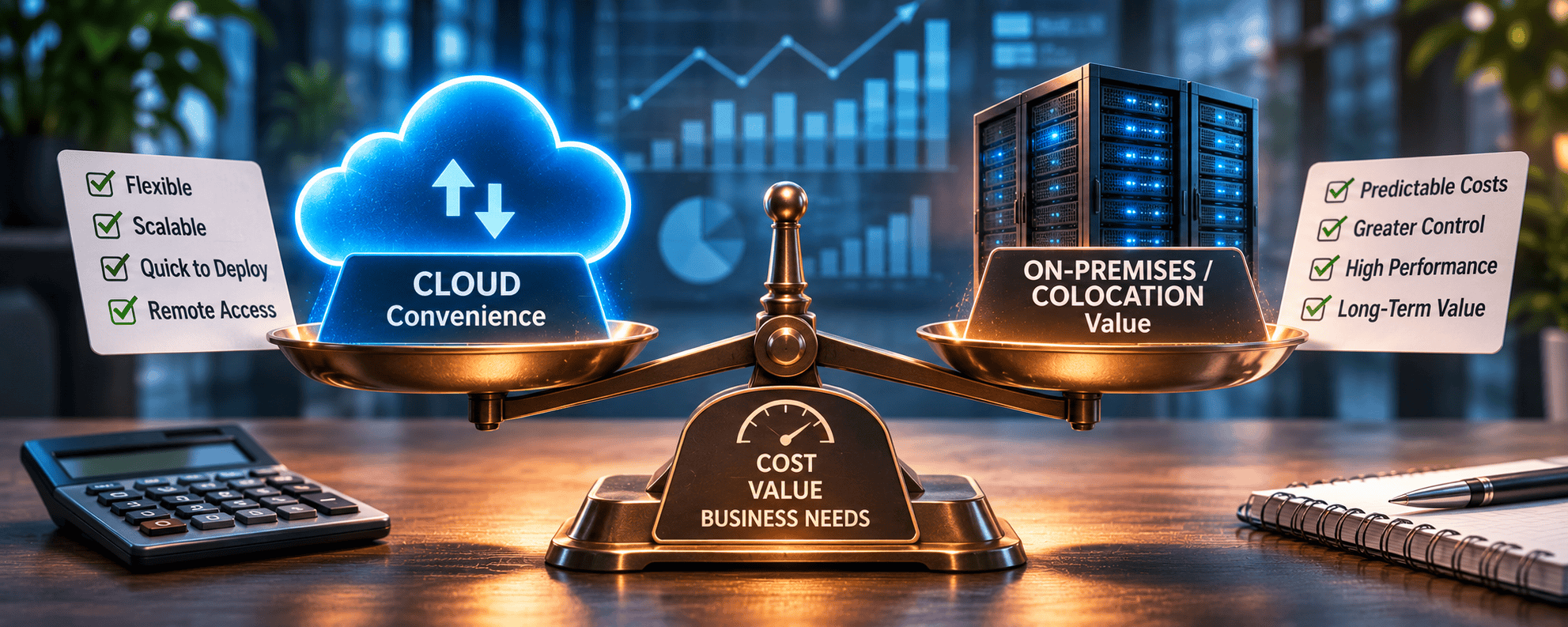
TL;DR: The Cloud Isn’t Automatically the Best Value
Cloud computing offers flexibility, scalability, and convenience, but it doesn’t always deliver the lowest cost.
Unused resources, oversized systems, growing storage requirements, and poorly managed subscriptions can make cloud infrastructure more expensive than expected.
For some businesses, private cloud, IaaS, colocation, or a hybrid approach may provide better long-term value.
The bottom line: Don’t choose infrastructure based on where everyone else is moving. Choose it based on performance, security, resilience, total cost, and what your business actually needs.
Remember when moving everything to the cloud was supposed to save your business money?
No more expensive servers. No more hardware replacements. Or no more maintaining equipment in a closet that probably doubles as a storage room.
Just move everything to the cloud, pay a monthly fee, and let someone else worry about the infrastructure. Sounds pretty good, doesn’t it? And for many businesses, it is.
Cloud computing offers flexibility, scalability, and accessibility that once required significant infrastructure investments.
But somewhere along the way, an interesting assumption took hold.
Moving to the cloud automatically saves money. Except it doesn’t. At least not always.
Some businesses discover their monthly cloud bills keep climbing. Others are paying for computing resources they barely use, storage they forgot existed, or services they don’t fully understand.
And some organizations discover that certain applications might cost less to operate in a private cloud or professionally managed data center.
The problem isn’t cloud computing. It’s assuming the cloud is always the right financial decision without evaluating what your business actually needs.
The Cloud Was Supposed to Make IT Simpler. What Happened?
One of the cloud’s biggest advantages is convenience.
- Do you need another server? Provision one.
- Need more storage? Add it.
- Need additional processing power? Increase capacity.
That flexibility is tremendous. But it also makes spending remarkably easy.
A server gets provisioned for a temporary project and never shut down. Storage grows because nobody reviews retention policies. Computing capacity increases even though applications don’t require it.
And every month, the bill arrives.
The AWS guidance on cloud cost management emphasizes monitoring usage, choosing appropriate pricing models, and identifying idle or overprovisioned resources.
These aren’t unusual problems. They’re predictable consequences of flexible technology without adequate financial oversight.
The cloud makes technology easy to consume. That doesn’t automatically make spending easy to control.
You’re Not Just Paying for Servers Anymore
Traditional infrastructure expenses were relatively straightforward.
You purchased servers, storage, networking equipment, software licenses, and support. You budgeted for maintenance and eventual replacement.
Cloud infrastructure changes that model.
Depending on the provider and architecture, businesses may pay for:
- Computing: Virtual machines, processors, memory, and application hosting.
- Storage: Capacity, performance tiers, snapshots, and retained data.
- Data transfer: Traffic between environments, regions, or external destinations.
- Backup and recovery: Storage, replication, and disaster recovery services.
- Security: Monitoring, logging, and threat protection.
- Licensing and management: Software subscriptions, administration, and support.
None of these charges is inherently unreasonable. The challenge is understanding how they combine.
Comparing the cost of purchasing a physical server against the monthly price of a cloud virtual machine rarely tells the whole story.
You also need to consider networking, backups, licensing, security, and management.
When evaluating on-premises infrastructure, you also need to include power, cooling, maintenance, facilities, and hardware replacement.
The question isn’t which option has the lowest advertised price. It’s which delivers the best total value over time.
Not Every Application Belongs in the Public Cloud
Different applications have different requirements.
- A customer-facing website with unpredictable traffic may benefit from cloud scalability.
- A development environment that operates only during business hours may benefit from consumption-based pricing.
But a business application requiring consistent processing power and substantial storage might have different economics.
And a legacy application with specialized hardware or licensing requirements may be expensive or difficult to migrate.
That’s why infrastructure decisions should be based on workloads, not a blanket commitment to one platform.
In Cloud, Colocation, or Both?, we explore why the right infrastructure strategy often combines different environments.
The goal isn’t to move everything to the cloud. It’s to put each application where it makes the most sense.
Sometimes the smartest cloud strategy involves using less public cloud.
Infrastructure-as-a-Service: Flexibility Without Owning Everything
Infrastructure-as-a-Service (IaaS) gives businesses access to computing, storage, and networking resources without purchasing and maintaining all the underlying hardware.
For many organizations, it offers a balance between flexibility and infrastructure management.
Depending on the solution, IaaS can provide:
- Predictable monthly infrastructure costs.
- Scalable computing and storage.
- Reduced responsibility for physical hardware maintenance.
- Public, private, or hybrid deployment options.
- Professional infrastructure management.
Through xCloud Infrastructure-as-a-Service, businesses can deploy public, private, and hybrid cloud environments.
Valued MSPs also support configurations combining cloud infrastructure with physical hardware housed in their data centers.
IaaS isn’t automatically the cheapest option either. The value depends on workload requirements, pricing, performance, and management.
The important distinction is having options.
Colocation: Sometimes Owning Hardware Still Makes Sense
Maintaining servers in an office introduces challenges involving power, cooling, physical security, connectivity, and disaster recovery.
But eliminating office-based infrastructure doesn’t necessarily mean eliminating privately owned hardware.
Colocation offers another option.
Businesses place their servers and networking equipment in a professionally managed data center while retaining ownership of the hardware.
For organizations with predictable computing requirements, substantial storage needs, or specialized applications, this can be worth evaluating.
Potential advantages include:
- Predictable expenses for stable workloads.
- Continued control over dedicated hardware.
- Professional power, cooling, and connectivity.
- Support for specialized applications.
- Integration with cloud infrastructure.
Data Center and Colocation Services provide flexible configurations, redundant infrastructure, managed services, and hybrid cloud options.
Colocation still involves hardware investments, maintenance, and replacement planning.
But for the right workload, it may provide a better balance of cost, performance, and control.
The cloud isn’t the only alternative to keeping servers in your office.
Hybrid Infrastructure Might Be the Smarter Decision
What if the best solution isn’t choosing between cloud and colocation? What if it’s using both?
A hybrid infrastructure strategy combines environments based on the needs of individual applications.
For example, a business might:
- Run customer-facing applications in the public cloud.
- Host predictable, resource-intensive workloads on dedicated infrastructure.
- Maintain legacy systems in a colocation environment.
- Use private cloud resources for sensitive applications.
- Leverage cloud services for backup and disaster recovery.
This approach avoids forcing every application into the same cost and operational model.
Hybrid Cloud and Colocation Services focus on selecting infrastructure based on performance, security, resilience, and business requirements.
Of course, hybrid environments introduce their own challenges involving connectivity, security, management, and complexity.
A poorly designed hybrid environment can cost more than an optimized cloud-only solution.
The objective isn’t to make infrastructure more complicated. It’s to make it more appropriate for your business.
Cloud Cost Management Isn’t a One-Time Project
Cloud cost optimization doesn’t end when migration is complete.
- Applications change.
- Storage grows.
- Employees come and go.
- Pricing models evolve.
An environment that was appropriately sized two years ago may no longer reflect current needs.
This is where FinOps becomes useful.
According to Microsoft’s FinOps documentation, FinOps brings financial management, engineering, and operations together to improve accountability for cloud spending and business value.
In plain English?
Someone needs to understand what you’re paying for, why you’re paying for it, and whether it’s delivering the expected return.
A practical cloud cost management program should include:
- Usage reviews: Identify unused resources, oversized systems, and unnecessary storage.
- Cost visibility: Understand which applications, departments, and projects drive expenses.
- Budgeting: Establish spending expectations and monitor unexpected changes.
- Workload optimization: Match resources to actual performance requirements.
- Pricing reviews: Evaluate reserved capacity, savings plans, and alternative service models.
- Infrastructure comparisons: Periodically determine whether workloads belong in their current environments.
The FinOps Framework emphasizes maximizing business value through collaboration and informed technology spending.
The objective isn’t necessarily to spend less. It’s to spend wisely.
The Cheapest Infrastructure Isn’t Always the Best Infrastructure
Suppose you identify a way to reduce your cloud bill by 20%. Sounds like a win.
But what if that change reduces performance, increases downtime risk, or creates security concerns?
Was it really a savings?
Infrastructure decisions should be considered more than monthly expenses.
Business leaders need to evaluate total cost of ownership, performance, scalability, security, resilience, and management requirements.
- Sometimes a more expensive cloud solution delivers enough operational value to justify its cost.
- Sometimes dedicated infrastructure provides better economics.
- And sometimes hybrid infrastructure offers the most sensible combination.
There’s no universal answer. That’s why infrastructure planning should begin with business requirements, not vendor marketing.
Your Cloud Bill Is Telling You Something. Are You Listening?
Here’s an interesting exercise.
Pull up your company’s cloud invoice from two years ago. Now compare it to today’s. Chances are, the number has changed. Maybe significantly.
But here’s the more interesting question. Has the value you’re getting increased at the same rate?
If your cloud spending has grown by 30%, has your business become 30% more productive? More secure? More efficient?
Probably not an easy question to answer. And that’s precisely the problem.
Cloud expenses have a way of becoming background noise. Another recurring charge that gets approved because, well, that’s what it costs to keep everything running.
But what if you treated your cloud infrastructure like any other major business investment?
You’d want to know what’s delivering value, what’s underperforming, and where your money might work harder.
- Perhaps that virtual server running 24/7 only needs to operate during business hours.
- Or you’re paying for storage nobody accesses.
- Maybe a predictable, resource-intensive application would cost less in a colocation facility.
- Or maybe your current cloud environment is exactly where it should be, but nobody has taken the time to verify it.
Here’s the challenge:
Ask whoever manages your cloud infrastructure to show you where your money goes and what your business gets in return.
Not just a spreadsheet of monthly charges.
An actual explanation of how those investments support your operations, security, performance, and growth. How does this solve real business problems?
If that conversation hasn’t happened recently, it’s probably overdue. Because the most expensive cloud resource might not be a server, storage, or bandwidth.
It might be the money you’re spending without ever questioning why.
Stop Asking Whether You Should Be in the Cloud
The cloud isn’t going away. Nor should it.
For many organizations, cloud computing provides tremendous value through flexibility, accessibility, scalability, and reduced infrastructure management.
But those advantages don’t mean every application belongs there. And they certainly don’t mean every cloud bill is justified.
The real opportunity is to evaluate your infrastructure as a business investment.
Understand what each application needs. Measure what you’re spending. Identify unnecessary costs. Compare alternatives.
That might mean optimizing your current cloud environment, moving workloads to a private cloud, using colocation, or combining approaches through hybrid infrastructure.
Through Cloud Solutions, businesses can evaluate IaaS, private and hybrid cloud, colocation, remote backup, and business continuity options.
The objective isn’t to sell businesses more cloud infrastructure.
It’s to help them make better decisions about what they actually need.
Because the question isn’t whether the cloud is worth the money. It’s whether your business is getting its money’s worth.
Schedule a Cloud Infrastructure and Cost Review with Xecunet