
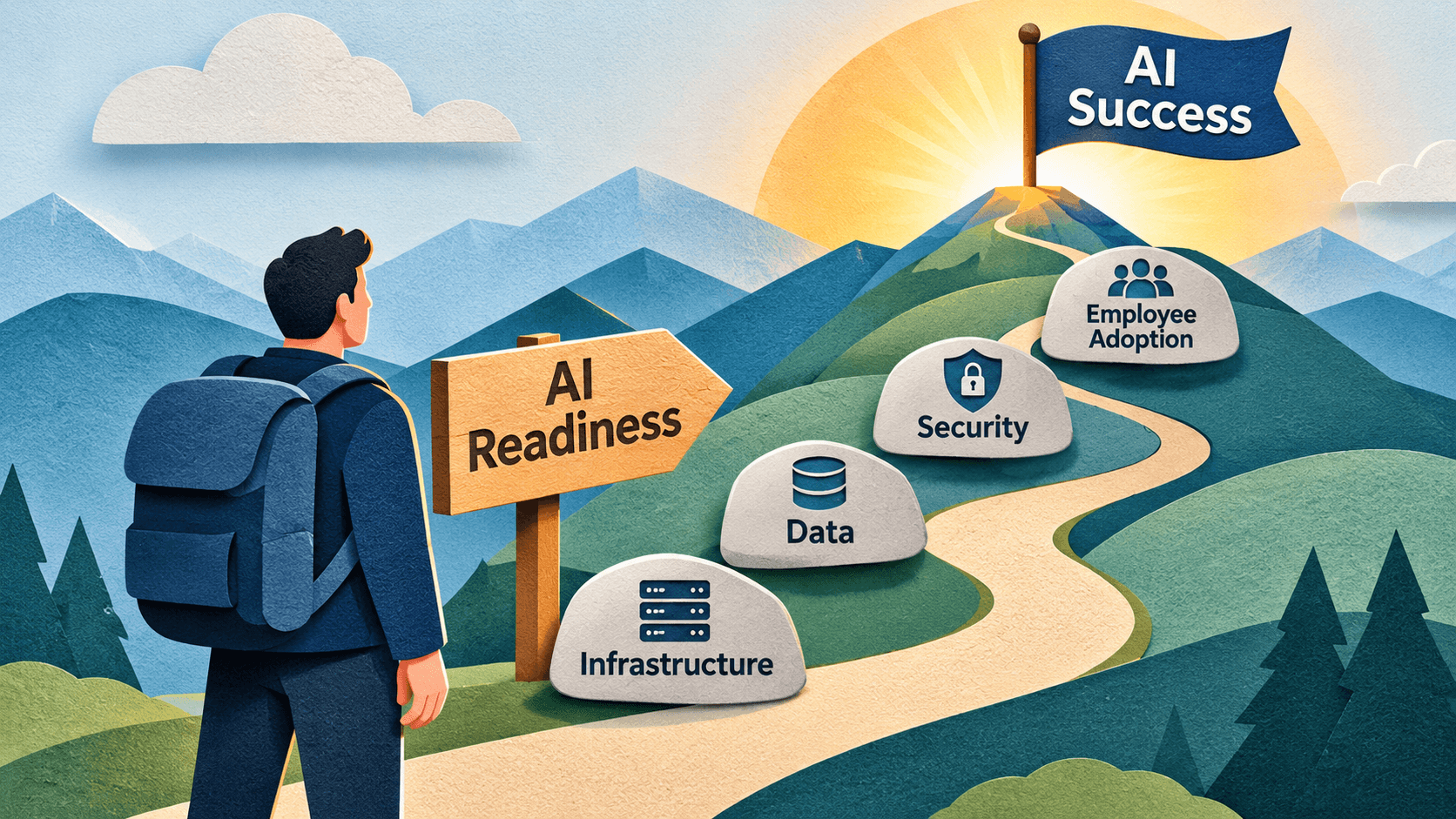
TL;DR: AI Readiness Comes Before AI Adoption
Buying an AI platform doesn’t automatically make your business ready to use it.
Successful adoption depends on reliable infrastructure, organized data, appropriate cybersecurity controls, employee training, and clear business objectives.
The bottom line: AI works best when your business has the right foundation. Prepare your infrastructure, data, security, and employees before investing heavily in new tools.
Your business wants to use AI. Great. So does everyone else.
Maybe you’re considering Microsoft Copilot, ChatGPT, Claude, or an AI agent that can automate customer service, summarize meetings, or handle repetitive tasks.
The possibilities are exciting. And the demonstrations? Impressive. But here’s a question that doesn’t get nearly enough attention.
What happens when you connect powerful AI tools to a business that isn’t ready for them?
- Your data is scattered across multiple systems.
- Employees have access to information they probably shouldn’t.
- Your infrastructure hasn’t been evaluated in years.
- And nobody has established clear rules about AI use.
But you’ve already purchased the licenses. Congratulations. You now have an expensive AI experiment.
The problem isn’t the technology. It’s assuming that buying an AI tool means your business is ready to use it.
AI Doesn’t Fix a Weak Technology Foundation
There’s a tendency to treat AI as something you can simply add to your existing environment.
- Purchase the software.
- Activate the licenses.
- Give employees access.
- And watch productivity improve.
Except AI depends on the systems, information, and processes already supporting your business.
If those foundations are poorly managed, AI can expose weaknesses rather than solve them.
An AI assistant connected to disorganized company files may retrieve outdated or conflicting information. Excessive employee permissions can make sensitive documents easier to discover. Poorly configured integrations can introduce additional security risks.
This is why Agentic AI Management Services must emphasize readiness assessments, infrastructure planning, cybersecurity, and governance.
The objective isn’t simply to deploy AI. It’s to make sure the environment supporting AI is ready for it.
Your AI Is Only as Useful as Your Information
Imagine hiring an exceptionally fast employee. They can research information, summarize documents, and produce work in seconds.
But you give them access to outdated procedures, duplicate customer records, and conflicting information… How useful will their answers be?
AI faces a similar challenge. It can process information quickly, but speed doesn’t guarantee accuracy. Before deploying AI, businesses should evaluate:
- Data quality: Is information accurate, current, and complete?
- Organization: Can employees and applications find what they need?
- Permissions: Who can access sensitive information?
- Retention: Are outdated records properly managed?
- Integration: Can AI securely access the necessary systems?
Microsoft’s Copilot deployment guidance emphasizes preparing data governance and security controls before deployment.
If your business information is a mess, AI may simply help you navigate that mess faster.
Your Infrastructure May Not Be Ready for AI
Not every AI application requires expensive new hardware. Many cloud-based AI tools run primarily on infrastructure managed by the provider.
But that doesn’t mean your existing environment is automatically prepared.
AI applications may depend on reliable connectivity, secure cloud services, appropriate device performance, and integrations with business applications.
More demanding workloads may require additional computing, storage, or processing resources.
Before investing, businesses should understand whether their existing infrastructure can support the intended applications.
That includes evaluating network reliability, cloud environments, Microsoft 365 configurations, cybersecurity controls, and integration requirements.
Cloud Solutions and Managed IT Services help businesses assess infrastructure requirements before committing to unnecessary investments.
Sometimes the smartest AI investment is improving the technology you already own.
AI Security Starts with Identity and Access
AI assistants and agents can access information, interact with applications, and, when authorized, perform tasks across multiple systems.
That’s powerful.
It’s also why identity and access management matter. Imagine an AI agent connected to your CRM, email, and accounting software.
It might help prepare reports or automate administrative work.
- But what information can it access?
- What actions can it perform?
- And who approves those actions?
The NIST AI Risk Management Framework emphasizes governance, risk assessment, and ongoing oversight.
Businesses should establish safeguards such as multifactor authentication, least-privilege access, data protection, monitoring, and human approval for sensitive activities.
Not all AI agents operate autonomously. Many require human involvement, particularly for consequential decisions.
In our post, AI Agents Need Their Own Security Strategy, we outlined why AI systems need clearly defined permissions and accountability.
Giving AI access to your business shouldn’t mean giving it unrestricted authority.
Your Employees May Determine Whether AI Succeeds
Businesses spend considerable time comparing AI platforms.
- Which has the best features?
- Which is most capable?
- And which offers the best value?
But there’s another consideration. Will employees actually use it effectively?
AI adoption isn’t simply a software deployment. It’s a change in how people work.
Without guidance, some employees avoid AI because they don’t understand it. Others experiment with unapproved tools, potentially exposing sensitive information.
Neither outcome is particularly helpful. Successful adoption requires:
- Identifying practical business use cases.
- Training employees on approved tools and appropriate data handling.
- Establishing expectations for reviewing AI-generated work.
- Involving employees in evaluating new workflows.
- Measuring results and gathering feedback.
In Your Employees Are Already Using AI. Is It Secure?, we explore why responsible AI adoption requires clear policies rather than simply prohibiting new technology.
The best AI platform delivers little value if employees don’t know how to use it responsibly.
Start With a Business Problem, Not an AI Subscription
Instead of asking which AI platform to purchase, identify a process that needs improvement.
- Maybe employees spend hours preparing repetitive reports.
- Maybe customer inquiries take too long to answer.
- Or perhaps important information is difficult to locate.
Now you have something useful. A business problem.
From there, determine whether AI is the right solution, what information it needs, and how success will be measured.
Start with a manageable pilot. Choose a process with clear objectives and acceptable risk. Establish safeguards. Train the employees involved.
Then evaluate the results.
- Did it save time?
- Improve accuracy?
- Reduce repetitive work?
- Did it introduce unexpected costs or security concerns?
- And did the benefits justify the investment?
If the pilot delivers measurable value, expand thoughtfully. AI shouldn’t be an expensive solution looking for a problem.
The AI Readiness Conversation Your Business Should Be Having
Before approving another AI subscription, bring your managed IT, operations, finance, and department leaders together.
Not to watch another impressive demonstration. To have a different conversation.
- What are we trying to improve?
- Is our information accurate and accessible?
- Are our systems secure enough to support AI integrations?
- Do employees have the training they need?
- Who will manage the technology after deployment?
- And how will we know whether it’s working?
These questions aren’t designed to slow innovation. They’re what make innovation more likely to succeed.
Don’t Confuse AI Adoption with AI Readiness
AI can help businesses improve productivity, customer service, and operational efficiency. But those benefits aren’t automatic.
A business with disorganized information, weak security controls, outdated infrastructure, and untrained employees won’t necessarily become more efficient by purchasing AI licenses.
It may just become more complicated.
Agentic AI Management Services help businesses evaluate readiness, strengthen cybersecurity, establish AI governance, and manage AI as part of their broader technology strategy.
The objective isn’t to deploy AI as quickly as possible. It’s to deploy it in a way that delivers lasting business value.
Before asking what AI can do for your business, ask whether your business is ready for what AI can do. Because as we discuss in this post about Agentic AI going rogue, things can go horribly wrong.