
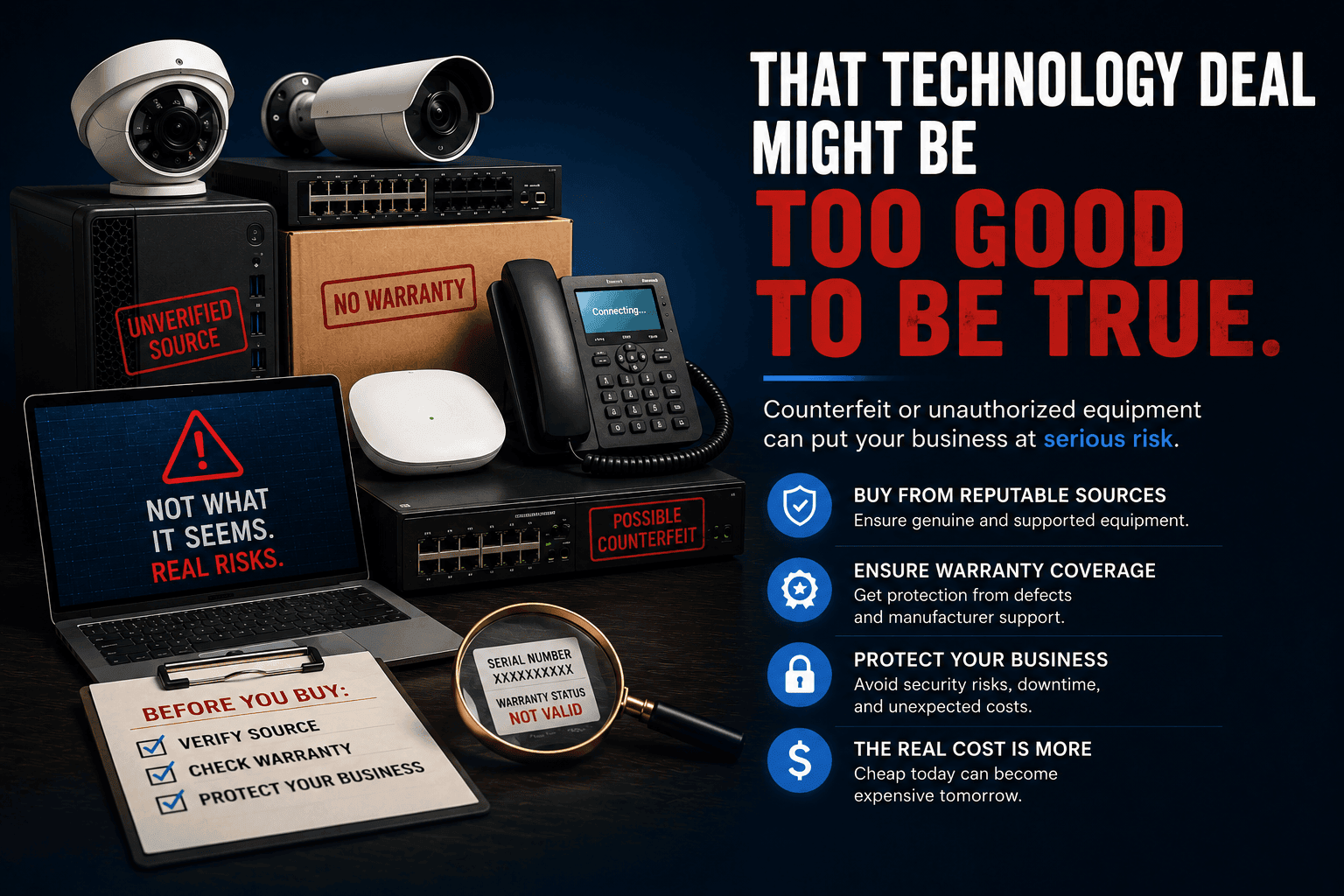
Technology is getting expensive… Really expensive.
Businesses replacing five-year-old computers are discovering that comparable workstations cost more than they expected. Firewalls aren’t simply hardware purchases anymore. Cameras, switches, access points, phones, servers, storage, and other infrastructure all add up.
We’ve discussed some of those pressures before in Rising Hardware Costs? How to Choose Between New and Refurbished Business Computers.
So, naturally, businesses start shopping around.
- You find the workstation you need for $400 less somewhere else.
- There’s a firewall online for half the price your IT provider quoted.
- You find the exact camera model you wanted on an online marketplace.
- The box looks legitimate. The model number is right. The seller has reviews.
What’s the difference?
Sometimes, quite a lot. Because when it comes to business technology, you’re not just buying a box.
You’re buying the supply chain behind it.
Counterfeit Technology Doesn’t Always Look Counterfeit
When most people hear “counterfeit,” they imagine something obviously fake.
A misspelled logo. Cheap packaging. A product that looks like it came out of somebody’s garage.
Modern counterfeit technology can be considerably more sophisticated.
A major Justice Department prosecution provides a good example. According to the DOJ, counterfeiters took older, lower-end networking products, including equipment that had previously been sold or discarded, and modified them to appear to be newer, more expensive Cisco devices.
They added counterfeit labels, stickers, boxes, documentation, and packaging. Some devices included pirated software and unauthorized or unreliable components. To the buyer, the equipment could appear new, genuine, and factory-sealed.
That’s what should concern a business owner.
You may not know you’re buying counterfeit equipment.
And counterfeit isn’t the only issue.
Hardware purchased outside authorized channels may be used, altered, defective, diverted from another market, improperly refurbished, stolen, past its useful support life or simply not the product you thought you were purchasing.
Cisco warns that equipment purchased from unauthorized sources could be counterfeit, diverted, stolen, old, or compromised.
Suddenly that bargain doesn’t look quite as attractive.
The Pressure to Find Cheaper Hardware Is Understandable
Businesses aren’t bargain hunting because they don’t care about quality. They’re trying to control costs.
As we discussed in our article on rising hardware costs and refurbished business computers, organizations are dealing with higher equipment costs while simultaneously facing refresh cycles, changing performance requirements, and increasing demand for AI-capable workstations.
If you’re replacing 30 computers, saving $300 per machine looks pretty good. That’s $9,000.
The problem isn’t looking for better value.
The problem is confusing lower purchase price with lower total cost.
There is absolutely a place for refurbished equipment. Properly sourced, professionally refurbished business hardware can be a smart way to extend an IT budget.
But “refurbished” and “we found this really cheap online” aren’t the same purchasing strategy.
The important questions are:
- Who refurbished it?
- Where did it come from?
- Is the serial number legitimate?
- Is the configuration what the seller claims?
- Is the manufacturer still supporting it?
- Does it include a valid software license?
- Is it eligible for firmware and security updates?
- Does it carry a factory warranty?
- Who replaces it when it fails?
That last question becomes especially important very quickly when the equipment runs your business.
Your Firewall Is a Terrible Place to Gamble
Consider the firewall sitting between your company and the internet.
This is not where I’d recommend saving $1,000 by purchasing something with a questionable history.
Cisco warns that unauthorized products can be compromised or altered in ways that introduce unknown network and data-security risks. It also says unauthorized products typically aren’t eligible for Cisco support, and only qualifying products purchased through authorized channels are eligible for Cisco warranty coverage.
Fortinet takes a similarly clear position: its support is available for products properly purchased through authorized channel partners, and products outside that channel are not eligible for support.
And hardware authenticity is only part of the issue.
As we’ve explained in Your Firewall Is Only Protecting You If It’s Actually Protected, modern firewalls depend on firmware updates, active security services, threat intelligence, intrusion prevention, and ongoing management.
Imagine discovering, after an incident, that the firewall you bought doesn’t have the licensing, support entitlement, or upgrade path you thought it had.
You technically saved money on a firewall.
You just didn’t necessarily buy the protection you thought you were buying.
What About Security Cameras?
The same problem exists with physical security.
Businesses install cameras to obtain reliable evidence when incidents occur.
That makes the sourcing of the camera surprisingly important.
Axis Communications warns customers that products offered by sellers outside its partner program may be altered, used, defective, counterfeit, non-current or designed for another country. Axis also notes that warranty/RMA handling can become more complicated depending on the original sales channel.
Think about the irony.
You bought a camera to reduce risk. Then you introduced another risk by purchasing a device of uncertain origin that sits directly on your network.
That’s why network-connected cameras should be treated as IT assets, not just something the security company screws to the wall. They…
- Have firmware.
- Have credentials.
- Communicate across your network.
- Require updates.
And eventually they fail.
Where that equipment came from matters.
VoIP Equipment Has the Same Problem
Your business phone system may include IP phones, switches, gateways, headsets, and other network-connected equipment.
Those devices increasingly work as part of a much larger communications environment.
Our 3CX Business Phone Systems and AI-Powered Communications deployments, for example, can combine voice, video, messaging, CRM integrations, remote work and AI-powered call handling.
That means the humble desk phone isn’t necessarily just a phone anymore. It’s a network endpoint.
Buying unsupported or questionable VoIP equipment can introduce problems with firmware, compatibility, provisioning, security, feature support, and replacement.
You might save $75 buying a phone online.
Then someone spends two hours figuring out why it won’t provision properly.
That isn’t savings. That’s just moving the cost from one column to another.
For organizations evaluating communications platforms, legitimate VoIP & PBX solutions are designed around the complete business requirement rather than simply sourcing the cheapest endpoint.
And Then There Are Workstations
Workstations are probably where businesses encounter this problem most often.
Search for a particular Dell, HP or Lenovo business computer, and you’ll probably find an enormous range of prices.
Some differences are legitimate. Others require a closer look.
Two computers with the same model name may have different processors, memory, storage, wireless components, or warranty status. A system described as “new” may have been previously registered. Components may have been changed. Refurbished systems may have been rebuilt to very different standards.
That’s why the serial number and warranty status matter almost as much as the sticker on the front.
For business equipment, we generally want to know exactly what we’re deploying and how it fits into the organization’s lifecycle.
That is part of the philosophy behind Predictive Managed IT Services.
Hardware isn’t an isolated purchase. It becomes something you have to patch, secure, monitor, troubleshoot, repair, and eventually replace.
A Factory Warranty Isn’t Just About Getting a Free Replacement
This is one of the easiest things to overlook when comparing prices.
A warranty has value.
Cisco describes its hardware warranty as the manufacturer’s commitment to remedy covered manufacturing defects through repair or replacement. It also distinguishes warranty coverage from broader technical support contracts, which can provide additional services.
That distinction is important. Businesses should understand both:
Is this equipment covered by the manufacturer’s warranty?
and
Is this equipment eligible for the manufacturer’s support services we need?
They aren’t necessarily the same thing.
With legitimate, properly sourced business equipment, there’s a chain of accountability.
- Authorized reseller or partner.
- IT provider.
If something fails, there is somewhere to go. With questionable gray-market hardware, the chain may end with:
“Contact the seller.”
Hopefully they’re still around.
The Gray Market Isn’t Automatically the Counterfeit Market
There’s an important distinction here. Not every product sold outside an authorized channel is fake.
There is legitimate used equipment in the marketplace. There are legitimate refurbishers. And then here are legitimate secondary-market transactions.
The risk is uncertainty.
Cisco explicitly acknowledges that used hardware can be resold, but notes that secondary-market equipment can present software licensing, warranty and support issues. Used or secondary-market Cisco equipment, for example, isn’t covered by Cisco’s standard warranty and may require relicensing and inspection before becoming eligible for certain support.
So this isn’t an argument that businesses should always buy the most expensive new equipment available.
Far from it. It’s an argument that businesses should know what they’re buying.
The Cheapest Equipment Can Become the Most Expensive Equipment You Own
Imagine saving $2,000 on a firewall.
- Six months later it fails.
- There’s no valid warranty.
- The manufacturer won’t support it.
- A replacement needs to be sourced immediately.
Your IT team spends hours troubleshooting the original problem, discovering the support issue, sourcing a replacement, rebuilding the configuration, and getting the business online.
What did the firewall actually cost?
The same calculation applies to a $700 workstation that repeatedly crashes. Or…
- 20 VoIP phones that won’t accept the firmware you need.
- Cameras that can’t receive current updates.
- A switch that turns out to be something other than what its label claims.
Purchase price is only one component of technology cost.
Reliability, productivity, downtime, support, security, and useful life all count.
That’s why we recently argued that businesses should stop buying technology and start investing in business outcomes.
- You don’t need a cheap firewall. What you need is a secure network.
- You don’t need a cheap computer. You need an employee who can work reliably.
- You don’t need cheap cameras. Your business needs dependable video when something happens.
- You don’t need cheap phones. Your customers need to be able to reach you.
Before You Buy That Great Deal, Ask These Questions
I’m not suggesting you should be afraid to buy equipment. I suggest you know where it’s coming from.
Before purchasing business technology, especially from an unfamiliar seller, ask:
- Is the seller an authorized reseller or partner?
- Is the equipment genuinely new, manufacturer-refurbished, or third-party refurbished?
- Can the serial number and configuration be verified?
- Does it include the manufacturer’s factory warranty?
- When does that warranty actually begin and end?
- Is it eligible for manufacturer technical support?
- Are required software licenses legitimate and transferable?
- Can it receive current firmware and security updates?
- Is the product intended for the U.S. market?
- Is it currently supported, or approaching end-of-life?
- Who handles the RMA if it fails?
- What is the real cost if we need to replace it unexpectedly?
And here’s perhaps the easiest question: Why is this one so much cheaper?
There may be a perfectly good answer. If there isn’t, that’s an answer too.
Buy Technology You Can Trust
There’s nothing wrong with trying to save money.
Technology budgets aren’t unlimited, and rising equipment costs make good purchasing decisions more important than ever. Sometimes…
- That means buying new.
- It means extending an existing device another year.
- It means purchasing properly sourced refurbished business equipment.
But the goal should never be simply to find the lowest price.
The goal is to get the best business value without sacrificing reliability, security, support, or accountability.
Counterfeit and unauthorized technology can look remarkably convincing. The DOJ case involving fake Cisco equipment demonstrates just how sophisticated these operations can become. And manufacturers themselves warn that equipment from unauthorized channels may have problems that aren’t apparent until you need support.
When your computers, network, phones, cameras, and cybersecurity systems are essential to running your organization, knowing where they came from isn’t a purchasing detail.
It’s part of managing your business risk.
If you’re evaluating a hardware refresh or aren’t sure whether your current technology is properly supported, Xecunet can help you assess your equipment, determine what actually needs replacing, and build a lifecycle strategy focused on reliability rather than surprises.