
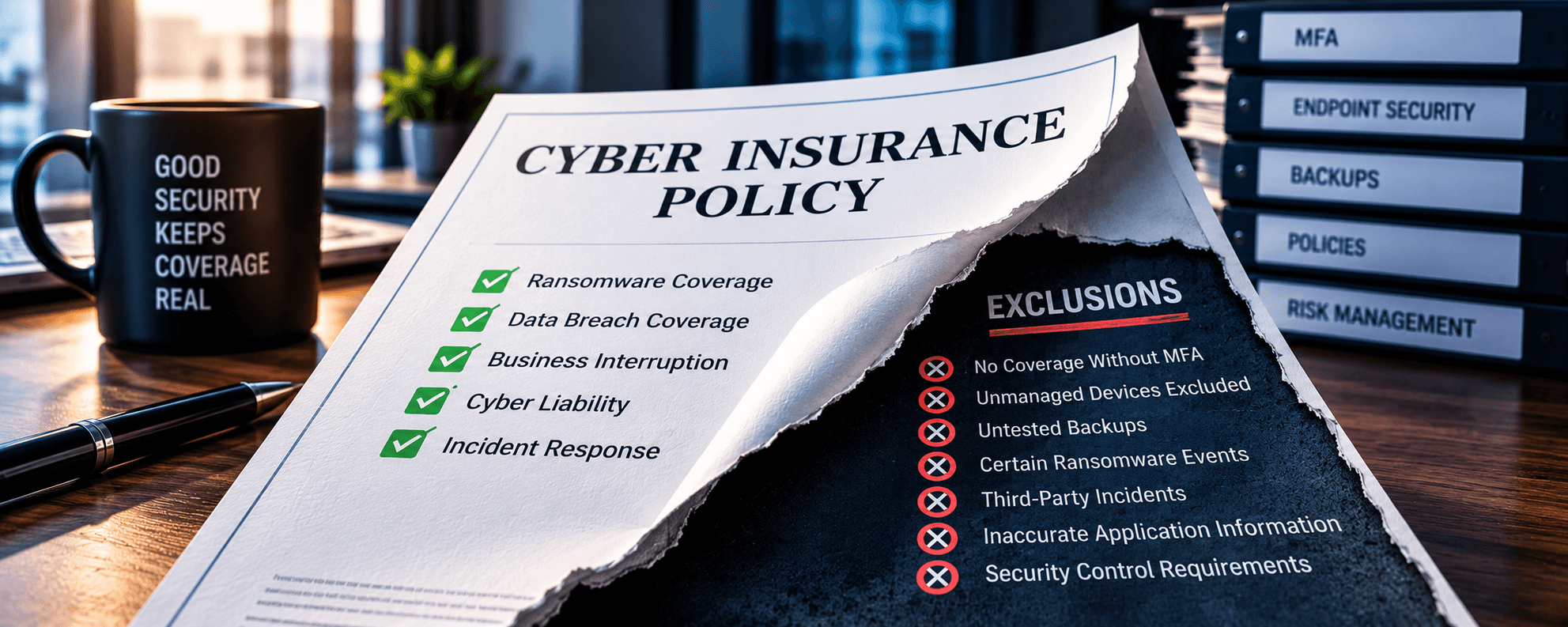
You have cyber insurance. But are you sure it will protect your business when you need it most?
Imagine your business is hit by ransomware. Systems are down, employees can’t work, customer information may be compromised, and recovery costs are mounting.
At least you have cyber insurance.
Then your insurer starts asking questions.
Was multifactor authentication enabled? Were your computers protected by endpoint security? Were your backups tested? Did your organization accurately describe its cybersecurity practices when applying for coverage?
Suddenly, the policy you thought would protect your business may not provide the financial protection you expected.
Having cyber insurance and meeting its requirements are two very different things.
TL;DR: What Business Leaders Need to Know
- Cyber insurance isn’t a guarantee. Coverage depends on your policy’s terms, exclusions, limits, and conditions.
- MFA and endpoint security matter. Insurers may require specific protections, and buying security software alone isn’t enough.
- Backups must work. Successful backup jobs don’t necessarily mean your business can recover from ransomware.
- Your insurance application matters. Inaccurate statements about cybersecurity practices can create serious coverage disputes.
- Cybersecurity requires ongoing management. As your business changes, you must monitor, maintain, and document security controls.
The bottom line: Don’t wait until you’re filing a claim to discover whether your cybersecurity practices match what your insurer expects.
Cyber Insurance Doesn’t Cover Everything
Cyber insurance can help businesses manage certain financial consequences of cyber incidents, including ransomware, data breaches, business interruption, and liability claims.
But coverage varies significantly.
According to the Federal Trade Commission’s Cyber Insurance Guide, businesses should understand the differences between first-party and third-party coverage and carefully review what their policies include.
Important considerations include:
- Business interruption: Are lost revenue and operational disruptions covered? Are there waiting periods?
- Social engineering: Does the policy cover fraudulent payments resulting from phishing or impersonation?
- Third-party incidents: What happens if a critical cloud provider or technology partner experiences a cyberattack?
- Incident response: Are you required to use approved forensic investigators or legal counsel?
- Exclusions and limits: Are certain incidents excluded or subject to lower coverage limits?
A $1 million cyber insurance policy doesn’t necessarily cover every cyber-related loss up to $1 million.
The time to understand these limitations is before an incident, not during one.
MFA: Having It Isn’t the Same as Enforcing It
Multifactor authentication (MFA) is one of the most effective ways to reduce the risk of unauthorized access.
But there’s a difference between enabling MFA and consistently enforcing it.
For example, your business may require MFA for Microsoft 365 email while overlooking:
- Administrator accounts with elevated privileges.
- Remote access and VPN connections.
- Cloud applications containing sensitive information.
- Former employee accounts or authentication exceptions.
- Vendors with access to business systems.
The Cybersecurity and Infrastructure Security Agency (CISA) recommends implementing MFA across business systems, particularly for remote access and privileged accounts.
If your insurance application states that MFA is enforced, the scope of that statement matters.
The question isn’t simply whether your business uses MFA. It’s whether MFA protects everything your policy requires.
We addressed this in the post Identity Is the New Security Perimeter.
EDR: Antivirus Alone May Not Be Enough
Traditional antivirus software remains useful, but modern cyberattacks often require more advanced detection and response capabilities.
Endpoint Detection and Response (EDR) helps identify suspicious activity on workstations, servers, and other supported devices.
However, installing EDR doesn’t automatically mean your business is adequately protected.
Consider these questions:
- Is EDR installed on every device that needs protection?
- Is it properly configured and receiving updates?
- Are security alerts actively monitored?
- Is someone responsible for investigating suspicious activity?
- Can compromised devices be isolated quickly?
Some insurers specifically ask about endpoint security capabilities, including EDR or managed detection and response.
If your business says these protections are in place, you should be able to verify that they’re operating.
Unmonitored security software can create a dangerous false sense of protection.
Cybersecurity Services help organizations address endpoint protection, monitoring, identity management, and incident response.
Backups: Are You Protected or Just Assuming You Are?
Your backup software reports success every morning. That’s good news.
But what happens when ransomware encrypts your systems, and you actually need to restore everything?
A successful backup doesn’t necessarily mean your business can recover. Ask yourself:
- Are all critical systems and data included?
- Are backups protected from ransomware?
- Has anyone tested restoring the data?
- Are backup credentials secured?
- How long would recovery actually take?
CISA’s StopRansomware Guide recommends maintaining protected backups and regularly testing recovery capabilities.
Some cyber insurance applications also ask about backup frequency, isolation, and recovery testing.
If your business claims to maintain these safeguards, those statements should reflect reality.
Your backup strategy should be measured by your ability to recover, not simply your ability to store data.
Cloud and Backup Solutions are essential for all businesses. Even if you are a small business and think no hacker will come after you, think again.
You need to be prepared and have a business continuity and disaster recovery plan.
Your Cyber Insurance Application Matters More Than You Think
Here’s where things can become especially uncomfortable.
Many businesses complete cyber insurance applications without involving the people who manage their technology.
- A business owner assumes MFA is enabled everywhere.
- A financial executive believes backups are regularly tested.
- Someone checks a box confirming that endpoint protection is deployed.
But has anyone verified those statements?
The problem isn’t necessarily dishonesty. It’s assuming cybersecurity controls exist without confirming that they do.
Depending on the policy, applicable law, and circumstances, materially inaccurate statements can lead to coverage disputes or other serious consequences. It happens more than you might think.
This doesn’t mean every technical oversight automatically results in a denied claim. Actual coverage depends on the policy and the facts.
However, businesses should involve both their insurance advisor and IT provider when completing or renewing coverage applications.
Your insurance advisor understands the policy. Your IT provider should understand the technology.
Both perspectives matter.
Cybersecurity Isn’t a One-Time Checklist
Even if your business met every insurance requirement when the policy was issued, your technology environment doesn’t stand still.
Employees come and go. New applications are introduced. Devices are replaced. Remote access changes. AI tools connect to business systems.
Security controls need to evolve alongside those changes.
The NIST Cybersecurity Framework 2.0 provides a practical approach to managing cybersecurity through six functions:
- Govern
- Identify
- Protect
- Detect
- Respond
- Recover
For businesses, that means maintaining visibility into:
- User identities, permissions, and MFA coverage.
- Workstations, servers, and endpoint protection.
- Software vulnerabilities and security updates.
- Backup integrity and recovery readiness.
- Incident response responsibilities.
- Documentation demonstrating that safeguards are maintained.
An ongoing cybersecurity strategy helps businesses reduce risk while providing more reliable information when insurance policies are reviewed or renewed.
This is why we encourage clients to invest in business outcomes rather than simply buying technology.
Five Questions to Ask Before Renewing Your Cyber Insurance
Before your next renewal, sit down with your insurance advisor and IT provider and ask:
- Are we meeting the cybersecurity requirements described in our policy and application?
- Is MFA enforced everywhere our policy requires it?
- Are our endpoints properly protected, monitored, and maintained?
- Have we tested our backups and documented our recovery capabilities?
- Do we understand our policy exclusions, coverage limits, incident notification requirements, and response procedures?
These questions won’t guarantee a future claim will be paid. But they can uncover gaps before those gaps become expensive problems.
Don’t Wait for a Claim to Discover Your Cybersecurity Gaps
Cyber insurance is an important part of managing business risk. But it shouldn’t be the first time you discover whether your cybersecurity controls actually work.
A ransomware attack is a terrible time to learn your backups haven’t been tested.
A compromised account is a terrible time to discover MFA wasn’t enforced.
And an insurance claim is a terrible time to find out your cybersecurity practices don’t match what was represented in your application.
The question isn’t simply whether you have cyber insurance. It’s whether your business is as protected as your insurance company thinks it is.
Businesses must identify cybersecurity gaps, implement safeguards, and maintain the protections they depend on through proactive managed IT and cybersecurity services.
Your insurance advisor should determine what your policy requires. Your IT partner should help verify that the technical safeguards behind those requirements are actually in place.
Don’t wait for an incident to find out what you don’t know.
Contact Xecunet to discuss your cybersecurity readiness.
Disclaimer: Cyber insurance coverage depends on individual policy language, application representations, endorsements, applicable law, and claim circumstances. This article provides general information, not legal or insurance advice. Consult your insurance advisor or legal counsel regarding specific coverage requirements.