
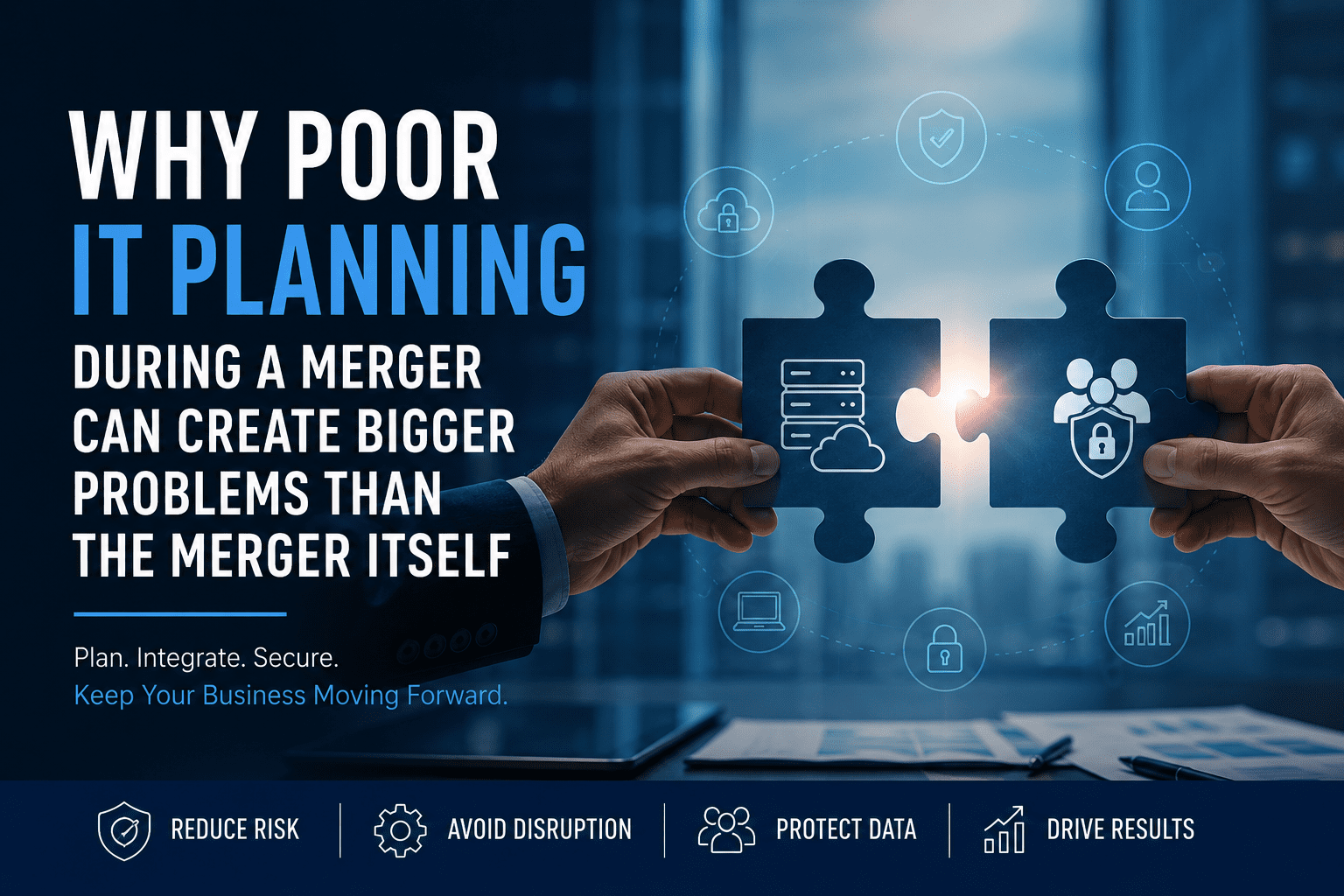
Most businesses first approach mergers and reorganizations from a financial and operational perspective. They focus on:
- Revenue growth
- Organizational alignment
- Staffing changes
- Cost efficiencies
But one of the biggest risks during a merger is often treated as secondary until something breaks… IT.
And when IT problems appear during a transition, they rarely stay isolated. They quickly impact:
- Operations
- Productivity
- Cybersecurity
- Customer experience
- Compliance
Because during a merger or reorganization, environments don’t just combine cleanly. They collide.
Why IT Becomes So Complex During a Merger
At a surface level, combining two organizations may seem straightforward. Both companies already have:
The assumption is often: “If both businesses already have IT, it should all work together.”
In reality, every environment is built differently. That means differences in:
- Security policies
- Endpoint protection
- Identity management
- Licensing
- Cloud architecture
- Backup and recovery strategies
Without a structured integration plan, organizations quickly create:
- Security gaps
- Duplicate systems
- User confusion
- Increased support complexity
According to PSM Partners, poorly managed IT integration is one of the primary reasons mergers fail to achieve expected operational efficiencies.
Cybersecurity Risk Increases During Transitions
One of the most overlooked realities of mergers is that they significantly increase cybersecurity exposure.
During transitions:
- Old accounts often remain active
- Permissions become inconsistent
- Security policies conflict
- Visibility decreases
- Teams move quickly under pressure
Attackers know this.
Organizations involved in mergers and acquisitions are frequently targeted because periods of transition create uncertainty and security gaps.
That’s why organizations should prioritize:
- Multi-factor authentication (MFA)
- Endpoint visibility
- Identity and access management
- EDR standardization
- Privileged access review
These should be put in place before environments are combined, not afterward.
This aligns closely with the identity-first security approach discussed throughout Xecunet’s cybersecurity content.
Modern cybersecurity is increasingly centered around identity. Hackers often don’t “hack” systems the traditional way anymore. They:
- Reuse stolen credentials
- Exploit unmanaged accounts
- Move laterally through environments quietly
That’s why visibility and standardization matter so much during mergers.
Microsoft 365 Migrations Are Usually More Difficult Than Expected
One of the biggest challenges during mergers is consolidating Microsoft 365. Organizations often have:
- Separate tenants
- Different Teams structures
- Different SharePoint permissions
- Specific retention policies
- Different security baselines
On paper, combining tenants can sound simple. In reality, small misconfigurations can create major disruption:
- Mail routing failures
- Broken permissions
- Duplicate identities
- Security gaps
- File access issues
According to CoreView’s Microsoft 365 Due Diligence Playbook, failed M365 integrations often stem from overlooked dependencies, excessive administrator privileges, and inconsistent tenant policies.
This is why organizations should evaluate:
- Tenant architecture
- Conditional access policies
- Device management
- Secure Score baselines
- Compliance requirements
These efforts need to happen before migration begins.
This also connects directly to the Microsoft 365 and identity-security strategy already emphasized throughout Xecunet’s Microsoft 365 content.
IT Standardization Before Consolidation Reduces Chaos
One of the fastest ways to create instability is to try to combine inconsistent systems too quickly. This commonly affects:
- Endpoint management
- Collaboration platforms
- Backup systems
- Security tooling
- Cloud applications
Successful organizations usually:
- Identify a primary platform first
- Align security policies
- Retire outdated systems gradually
- Consolidate duplicate tools in phases
This reduces:
- Licensing waste
- User confusion
- Security exposure
- Operational disruption
And it creates a smoother experience for employees during an already stressful transition.
According to Sourcepass, phased IT consolidation strategies significantly reduce productivity loss and operational disruption during post-merger integration.
Day One Planning for IT Migration Is Not Enough
A merger is not a single event. It’s a process.
Strong IT integration strategies account for multiple phases:
Day 0: Assessment & Due Diligence
- Evaluate infrastructure and risk
- Assess cybersecurity posture
- Identify system overlap
Day 1: Operational Continuity
- Maintain communication
- Preserve user access
- Prevent downtime
Day 30+: Long-Term Optimization
- Consolidate platforms
- Improve security
- Standardize workflows
Organizations that try to compress all of this into a single phase often cause more disruption than the merger itself.
Communication and Change Management Matter More Than Most IT Teams Realize
Even technically successful migrations can fail operationally if employees:
- Don’t know what’s changing
- Lose access unexpectedly
- Receive inconsistent communication
- Struggle with new workflows
That’s why change management matters. Employees need:
- Clear communication
- Training
- Support resources
- Realistic expectations
Because mergers are not just technical projects. They’re operational and cultural transitions too.
Why a Strong MSP Matters During a Merger
This is where a proactive MSP approach becomes critical. Because mergers don’t just require support.
They require:
- Strategic IT planning
- Security oversight
- Continuous monitoring
- Infrastructure visibility
- Operational continuity
A strong managed IT strategy helps organizations:
- Maintain stability
- Reduce cybersecurity risk
- Standardized systems efficiently
- Support users during change
- Prevent small problems from becoming major disruptions
This aligns closely with the predictive IT approach we’ve discussed in our managed IT content. Instead of reacting after systems fail, organizations can proactively identify:
- Security gaps
- Integration bottlenecks
- Weak infrastructure
- Operational risks
You need to address these issues before they become business problems.
Managed IT Services Planning Is Critical During a Merger or Reorganization
Most IT disasters during mergers and reorganizations are not caused by technology itself. They’re caused by:
- Poor planning
- Rushed integration
- Lack of visibility
- Inconsistent security
- Communication breakdowns
The organizations that navigate transitions successfully treat IT as foundational infrastructure rather than an afterthought.
Because during a merger:
- Systems must remain operational
- Users must stay productive
- Data must stay secure
- Customers must stay connected
If not, the transition itself becomes the biggest threat to the business. If you’re concerned about your merger or reorg, we can help.