
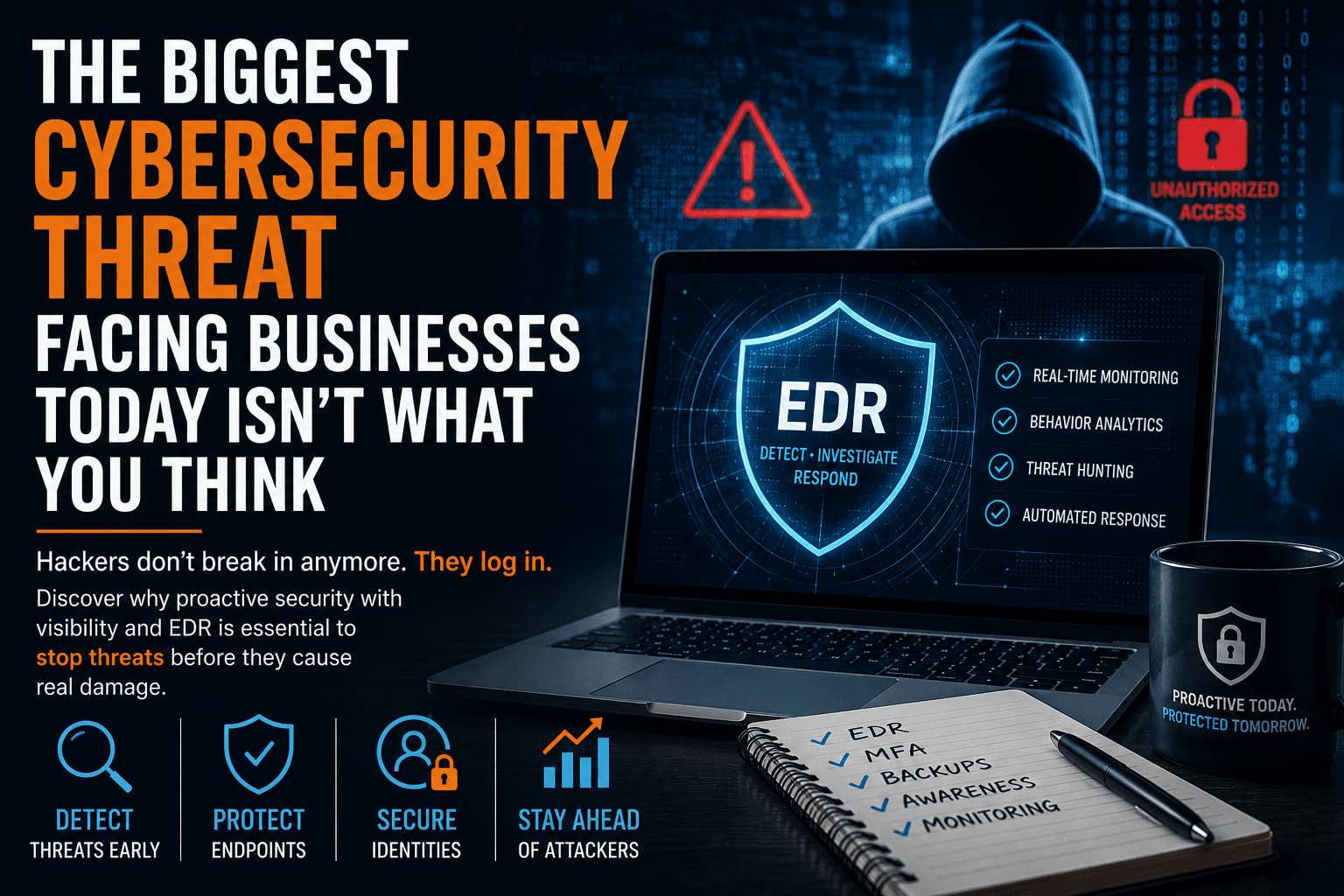
Most businesses still think about cybersecurity the same way they did ten years ago.
- Install antivirus.
- Deploy a firewall.
- Train employees not to click suspicious links.
- Hope for the best.
The problem is that today’s attackers aren’t operating the same way they were ten years ago.
Modern cybercriminals rarely rely on brute force attacks or obvious malware. Instead, they focus on exploiting identities, leveraging legitimate credentials, and quietly moving through environments without triggering traditional security tools.
In many cases, organizations don’t realize they’ve been compromised until weeks or months after the initial breach.
That’s why one of the biggest cybersecurity challenges businesses face today isn’t simply stopping attacks.
It’s detecting them before they become business-ending events.
Hackers Don’t Break in Anymore. They Log In.
For years, cybersecurity strategies focused on keeping attackers outside the network.
That model no longer reflects reality.
According to Microsoft’s Digital Defense Report, identity-based attacks continue to increase as threat actors target user credentials, privileged accounts, and cloud environments.
Attackers understand that stealing a password is often easier than exploiting a firewall.
Once legitimate credentials are compromised, attackers can frequently access email systems, cloud platforms, business applications, and sensitive data while appearing to be authorized users.
This shift is one reason many cybersecurity experts now say:
The New Perimeter is Identity
Organizations that continue relying on traditional security models often struggle to detect these types of attacks until significant damage has already occurred.
Visibility Has Become the New Security Requirement
One of the most common findings after a cybersecurity incident is that warning signs existed long before anyone noticed.
- An unusual login.
- A compromised account.
- A suspicious process running on a workstation.
- Unexpected file access.
- The activity was there.
- The visibility wasn’t.
According to CISA’s Cybersecurity Performance Goals, organizations should prioritize continuous monitoring, endpoint visibility, and threat detection capabilities to reduce risk and improve incident response.
This represents a major shift in cybersecurity thinking. Security is no longer just about prevention. It’s about visibility.
Because you can’t respond to threats you can’t see.
Why Traditional Antivirus Is No Longer Enough
Many businesses still rely primarily on traditional antivirus software.
While antivirus software remains useful, it was designed for a different era of cybersecurity.
Traditional antivirus tools primarily identify known malicious files using signatures and threat intelligence.
Modern attackers increasingly use:
- Fileless malware
- Living-off-the-land techniques
- Credential theft
- Legitimate administrative tools
- Cloud-based attack methods
These techniques often bypass traditional antivirus protections entirely.
According to CrowdStrike’s Modern Threat Report, attackers continue to reduce breakout times and increasingly leverage legitimate tools and stolen credentials to evade detection.
This means organizations need more than prevention. They need visibility into what is actually happening on their endpoints.
EDR Is a Great Example of Proactive Security
This is where Endpoint Detection and Response (EDR) becomes important.
Unlike traditional antivirus software, EDR is designed to continuously monitor endpoint activity, identify suspicious behavior, investigate potential threats, and provide security teams with the visibility needed to respond quickly.
Rather than simply asking:
“Is this file known malware?”
EDR asks:
“Is this behavior unusual?”
That distinction matters.
An EDR platform can identify:
- Suspicious account activity
- Unauthorized privilege escalation
- Lateral movement attempts
- Ransomware behavior
- Credential theft activity
- Unusual processes and commands
before they become full-scale incidents.
This aligns closely with the proactive approach emphasized through Cybersecurity Services.
Because cybersecurity today is less about building higher walls and more about detecting threats before they achieve their objectives.
The Most Important Cybersecurity Issues Businesses Face Today
While threat actors continue to evolve, several risks consistently appear across industries.
Identity-Based Attacks
Compromised credentials remain one of the most common attack vectors.
Organizations should prioritize:
- Multi-factor authentication
- Identity governance
- Access reviews
- Privileged access management
According to NIST’s Cybersecurity Framework 2.0, identity and access management remain foundational cybersecurity controls.
Ransomware
Ransomware continues to disrupt organizations of all sizes.
The financial impact often extends beyond the ransom itself and includes downtime, recovery costs, reputational damage, and lost productivity.
According to CISA’s Ransomware Resources, organizations should implement layered security controls, backups, monitoring, and incident response planning to improve resilience.
Remote and Hybrid Work
Employees increasingly access business systems from:
- Home offices
- Personal devices
- Mobile devices
- Public networks
This expanded attack surface makes endpoint visibility and device management more important than ever.
Organizations need visibility into the devices accessing company resources and confidence that those devices are properly secured.
Shadow IT and Shadow AI
Employees often adopt applications and AI tools without IT oversight.
While these tools may improve productivity, they can also create security, compliance, and data governance challenges.
Businesses need policies, monitoring, and governance processes that help balance innovation with security.
Reactive Security Is No Longer Enough
For many organizations, cybersecurity still follows a reactive model.
- A threat is discovered.
- An incident occurs.
- A response follows.
The problem is that modern attacks often move too quickly for reactive approaches.
According to IBM’s Cost of a Data Breach Report, organizations that identify and contain breaches more quickly typically experience significantly lower financial impacts than those with slower response times.
The lesson is simple: The earlier you detect a problem, the easier and less expensive it is to contain.
That’s why proactive monitoring, EDR, identity security, and continuous visibility have become critical components of modern cybersecurity strategies.
Cybersecurity Is Becoming a Business Issue
Many business leaders still view cybersecurity as an IT responsibility.
It is increasingly becoming a business responsibility. Cybersecurity now affects:
- Business continuity
- Customer trust
- Regulatory compliance
- Cyber insurance eligibility
- Operational resilience
- Financial performance
Organizations that view cybersecurity as a strategic business function are often better positioned to adapt to evolving threats and reduce long-term risk.
Cybersecurity Is a Quiet Threat
The most dangerous cybersecurity threats facing businesses today are not always the loudest.
They’re often the ones operating quietly in the background.
- A compromised account.
- An unmanaged device.
- An unusual login.
A malicious process that looks legitimate.
The organizations that succeed in today’s threat landscape won’t simply be the ones that deploy more security tools.
They’ll be the ones that gain visibility into their environment, identify risks earlier, and adopt a proactive approach to cybersecurity.
Because when it comes to security, finding a threat after the damage is done isn’t protection.
It’s an incident response. And then, it’s often too late.
Is your cybersecurity setup prepared for modern threats? If not, we can help.