
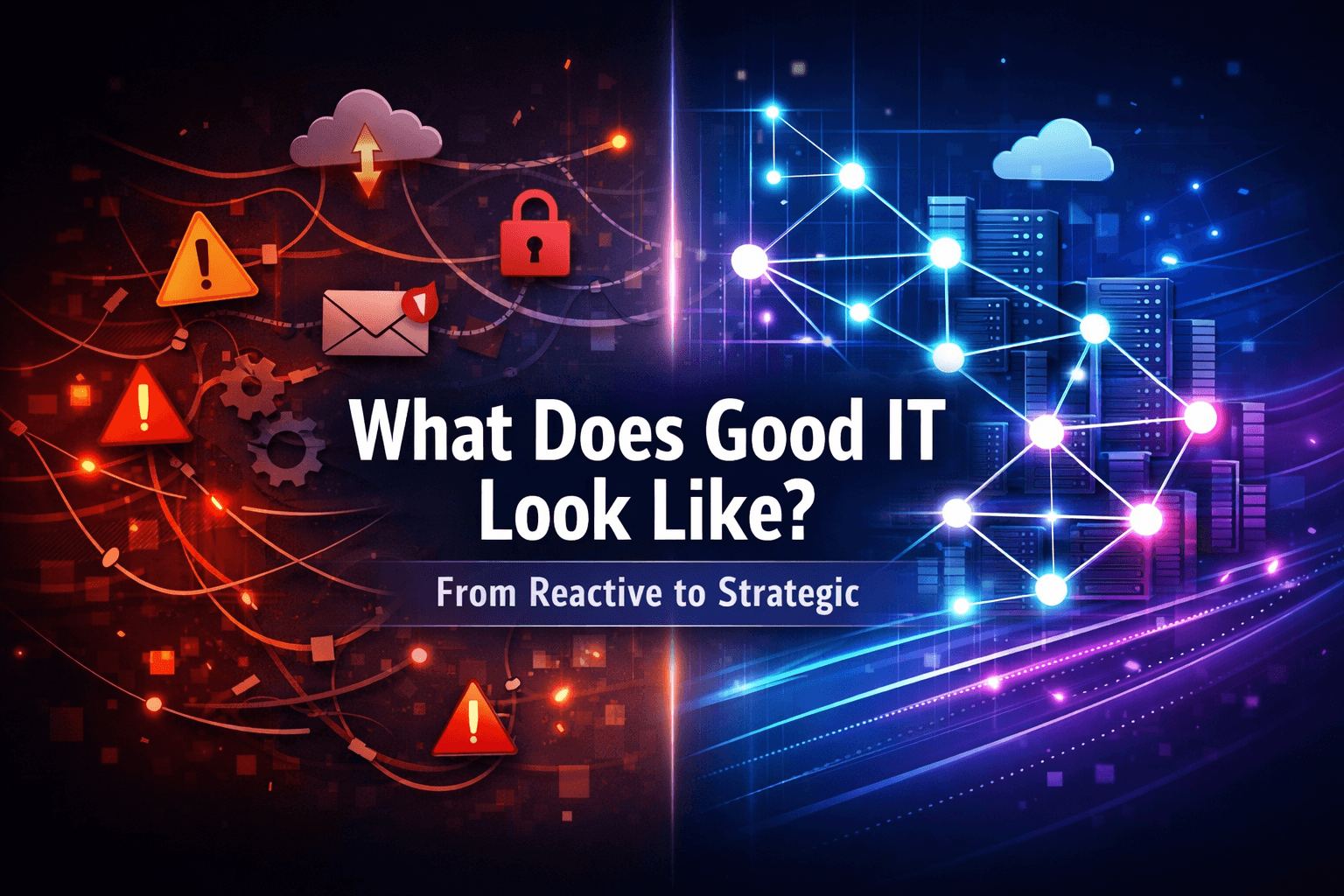
Most business owners I talk to think their IT is “fine.” And to be fair, it probably is… on the surface.
- The systems are up
- The team can log in
- Email is working
- There’s someone to call when something breaks
But here’s the question I usually ask next:
Is your IT actually helping your business move forward or just keeping it running?
Because those are two very different things.
The Reality: “Working” IT Isn’t the Same as Good IT
Many small and mid-sized businesses have IT environments that function, but aren’t:
- Secure in a meaningful way
- Built to scale
- Aligned with business goals
- Designed to reduce risk
And that’s where the problems start. Not all at once. Not dramatically.
But slowly, over time:
- Costs creep up
- Systems get more complex
- Security gaps widen
- Decisions become reactive
Organizations like the National Institute of Standards and Technology emphasize that effective IT isn’t just about tools, it’s about a structured, risk-based approach to managing technology.
In other words: good IT is intentional.
So, What Does Good IT Look Like?
When we work with businesses, we’re not just trying to fix issues. We’re trying to build environments that actually support how the business operates and grows.
In 2026, that usually comes down to four core pillars.
Proactive IT (Not Just Support)
If your IT strategy starts when something breaks, you’re already behind.
Good IT means:
- Systems are monitored continuously
- Issues are prevented before they impact users
- Updates and lifecycle management are planned, not rushed
This is the foundation of Managed IT Services, but, more specifically, Proactive or Predictive IT.
It’s the difference between:
- “Call us when something’s wrong.” and
- “We’re making sure things don’t go wrong in the first place.”
Cybersecurity That’s Built In, Not Bolted On
Cybersecurity is where I see the biggest disconnect. A lot of businesses have:
- Antivirus
- A firewall
- Maybe backups
But that’s not a strategy, that’s a starting point.
Real cybersecurity today includes:
- Identity and access control
- Endpoint protection
- Backup and disaster recovery
- User awareness
- Continuous monitoring
The Cybersecurity and Infrastructure Security Agency makes it clear that layered, integrated defenses are essential for modern organizations.
Security isn’t something you add later. It must be part of how everything is designed.
For a deeper breakdown, here’s how we approach cybersecurity for small businesses in real-world environments.
Cloud That Actually Supports the Business
“Moving to the cloud” was once the goal. Now, it’s just the starting point.
What matters is:
- How your cloud environment is structured
- Whether it’s secure
- Whether it scales with your business
- Whether you’re paying for what you actually need
We see a lot of environments that are technically “in the cloud”… but still:
- Overcomplicated
- Under-secured
- More expensive than they should be
A more strategic approach, such as what we build with scalable cloud solutions designed for business performance and reliability, focuses on performance, redundancy, and alignment with how your team actually works.
Communication That Removes Friction
Your phone system shouldn’t feel like it’s stuck in 2012. And yet… for many businesses, it does.
Modern communication systems should:
- Support remote and hybrid work
- Integrate with business tools
- Enable collaboration, not slow it down
Platforms like 3CX are a good example of how voice, chat, and workflow can come together in one system.
And when implemented correctly with solutions such as VoIP systems like 3CX, it becomes a driver of productivity, not a bottleneck.
What Most Businesses Are Missing with Their Managed IT, Cloud, and VoIP
This is where having a clear strategy makes the difference. When we step back and look at struggling environments, the issue is usually not a single tool. It’s this:
There’s no clear strategy to try everything together.
That shows up as:
- Multiple vendors with no coordination
- Tools that don’t integrate well
- Security that’s inconsistent across systems
- No roadmap for what comes next
Everything works… until it doesn’t.
IT Should Be a Business Function
This is the biggest change happening right now. IT is no longer just:
- Support
- Troubleshooting
- Maintenance
It’s now:
- A security layer
- An operations platform
- A growth enabler
That’s why more businesses are moving toward strategic IT guidance, not just supporting decisions on where the business is going.
Here’s how businesses are approaching IT strategy and vCIO planning to align technology with growth.
A Simple Way to Evaluate Your IT
If you’re not sure where you stand, start here:
- Are we preventing issues or reacting to them?
- Is our security integrated or pieced together?
- Does our IT scale with our business?
- Do we have a plan or just a collection of tools?
If those answers aren’t clear, that’s usually a sign there’s an opportunity to improve.
Good IT Doesn’t Happen by Accident
It’s planned. It’s aligned. And it’s continuously improved.
The businesses that get this right aren’t just avoiding problems. They’re building environments that help them move faster, operate more efficiently, and stay secure.
And in today’s environment, that’s not a luxury. It’s a requirement.
If you’re not sure whether your IT is where it should be, that’s a good place to start.
Let’s look at where you are and where you want to go.