
When economic uncertainty rises, many businesses look for places to reduce spending.
Technology is often one of the first budgets placed under scrutiny.
Servers get another year of life. Workstation replacements are delayed. Software upgrades are postponed. Cybersecurity projects move to the next quarter. Infrastructure investments are pushed further down the road.
On the surface, these decisions seem financially responsible.
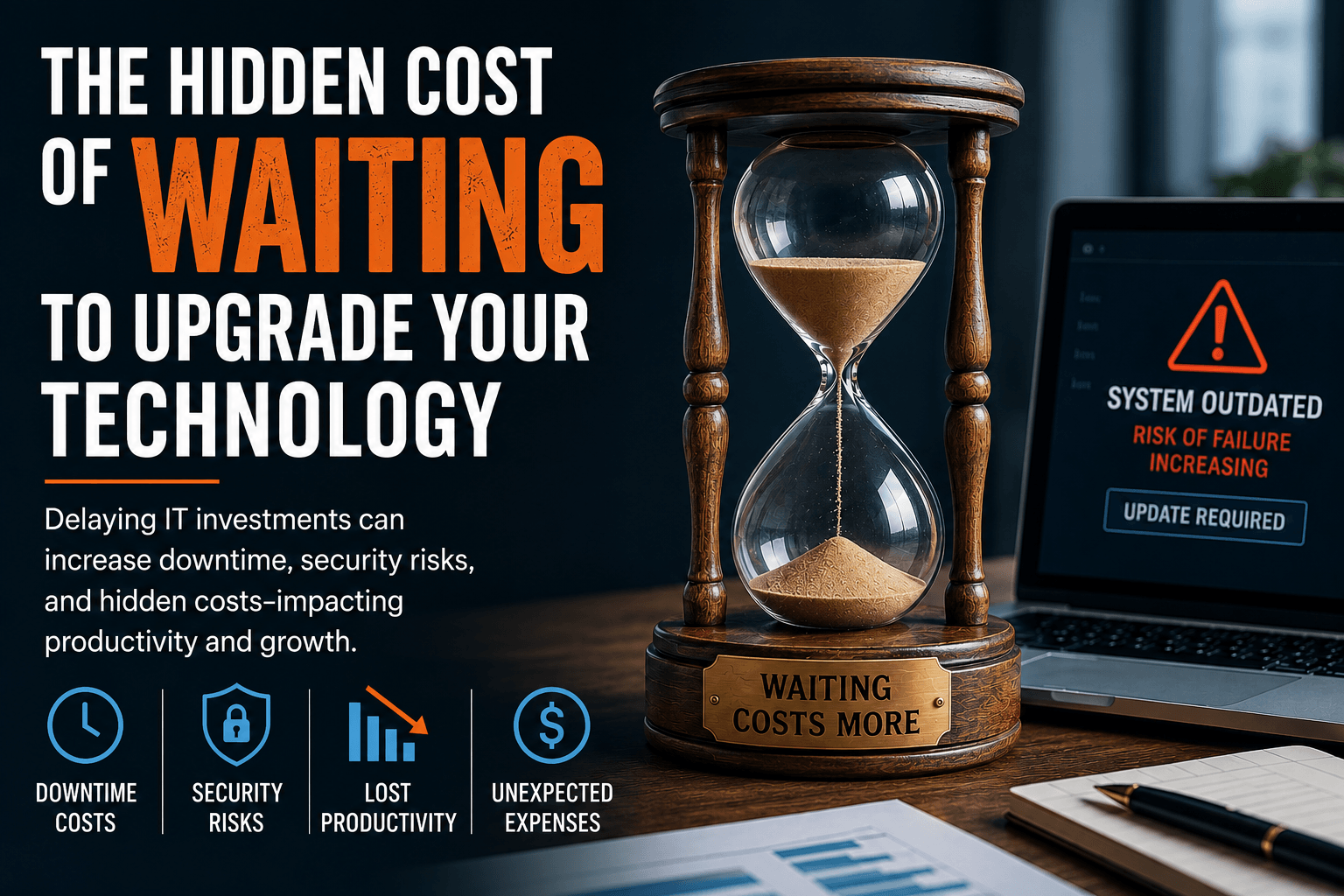
The problem is that delaying technology investments rarely eliminates costs. More often, it shifts those costs into the future, where they become larger, more disruptive, and more difficult to control.
What looks like savings today can become downtime, security incidents, productivity losses, and unexpected capital expenses tomorrow.
The Cost of Standing Still
Most organizations don’t replace technology because it’s new. They replace it because aging systems eventually affect the business.
Older hardware becomes less reliable. Legacy software becomes harder to support. Security vulnerabilities accumulate. Employees spend more time working around limitations instead of focusing on customers and revenue-generating activities.
This is often referred to as technical debt, the hidden cost of relying on outdated technology instead of investing in modernization.
According to Deloitte’s research on technical debt and growth, infrastructure modernization can significantly reduce technical debt while improving an organization’s ability to generate business value and support future growth.
Deloitte’s research also found that technical debt can consume a substantial portion of IT spending, diverting resources away from innovation and strategic initiatives.
In other words, waiting often costs more than moving forward.
Downtime Is More Expensive Than Most Businesses Think
One of the most overlooked consequences of aging technology is downtime.
Businesses often assume that if systems are still functioning, there is little urgency to replace them. However, older infrastructure is generally more susceptible to hardware failures, software issues, and compatibility problems.
When critical systems become unavailable, the impact extends far beyond the IT department. Downtime can affect:
- Employee productivity
- Customer service
- Sales operations
- Vendor communications
- Regulatory compliance
- Revenue generation
A single outage can quickly erase years of perceived savings from delaying upgrades.
This is why proactive technology management remains a core component of Managed IT Services. The goal is not simply fixing technology when it breaks. The goal is to identify risks before they become business interruptions.
Cybercriminals Love Outdated Technology
The longer organizations wait to modernize, the larger their attack surface often becomes.
Unsupported operating systems, unpatched applications, aging firewalls, and obsolete hardware frequently become attractive targets because attackers know they are harder to defend.
Recent research surrounding legacy technology and technical debt found that organizations operating outdated systems often experience higher security risks, increased downtime, and greater compliance challenges.
This is particularly important as cyber insurance providers continue increasing security requirements related to:
- Multi-factor authentication
- Endpoint protection
- Vulnerability management
- Backup and recovery
- Identity security
Businesses that delay modernization often delay security improvements at the same time. That creates risk that extends far beyond IT.
This is why organizations increasingly align technology lifecycle management with broader cybersecurity strategies such as those offered through Cybersecurity Services.
The Productivity Problem Nobody Measures
Many technology costs never appear on a financial report.
- Employees waiting for slow applications.
- Systems requiring constant reboots.
- Manual workarounds for outdated software.
- Incompatible applications that cannot integrate with modern cloud platforms.
- Individually, these frustrations seem minor.
Collectively, they create thousands of hours of lost productivity every year.
According to Protiviti’s Global Technology Executive Survey, nearly 70% of organizations report that technical debt significantly impacts their ability to innovate and move their business forward.
The cost isn’t just slower technology. The cost is slower business.
Aging Technology Makes AI Harder to Adopt
One of the most significant business conversations today revolves around AI.
Organizations are exploring Microsoft Copilot, agentic AI, workflow automation, and data-driven decision making. Yet many businesses are trying to build modern AI strategies on top of aging infrastructure.
That’s becoming increasingly difficult.
Successful AI adoption requires more than selecting the right platform. According to Microsoft’s AI Adoption Framework, organizations need a strong foundation of cloud infrastructure, data governance, security controls, and operational readiness to successfully deploy and scale AI initiatives.
AI readiness requires more than software. It requires:
- Modern workstations
- Cloud infrastructure
- Secure identities
- Reliable networks
- Quality data
- Strong cybersecurity controls
This aligns closely with the work we do across Managed IT Services, Cybersecurity, Cloud Solutions, Microsoft 365, and AI readiness initiatives.
Businesses That Win Think Long-Term
Economic uncertainty often causes businesses to become more cautious. That’s understandable.
But there is an important difference between reducing unnecessary spending and delaying necessary investments.
Organizations that consistently outperform competitors tend to view technology as a strategic asset rather than a cost center. They understand that modern infrastructure improves productivity, reduces risk, supports growth, and creates flexibility when market conditions change.
Gartner’s guidance on managing infrastructure technical debt states that organizations that take a structured approach to reducing technical debt and modernizing infrastructure can significantly reduce obsolete systems and improve long-term operational efficiency.
Technology investments should not be viewed solely through the lens of cost. They should be evaluated through the lens of business impact.
The Biggest Technology Risks are the Ones Businesses Don’t See.
- An aging server that hasn’t failed yet.
- A workstation that is still functioning but is slowing employees down.
- A firewall that is approaching end-of-life.
- An unsupported operating system that has not yet been targeted.
These issues rarely create immediate pain. Instead, they quietly accumulate risk, inefficiency, and hidden costs over time. The organizations that succeed in uncertain economic conditions are not necessarily the ones that spend the least on technology.
They are often the ones who invest strategically, modernize proactively, and avoid letting today’s savings become tomorrow’s business problem.
Because when it comes to technology, waiting is rarely free. Ready to become proactive? Let’s talk.