
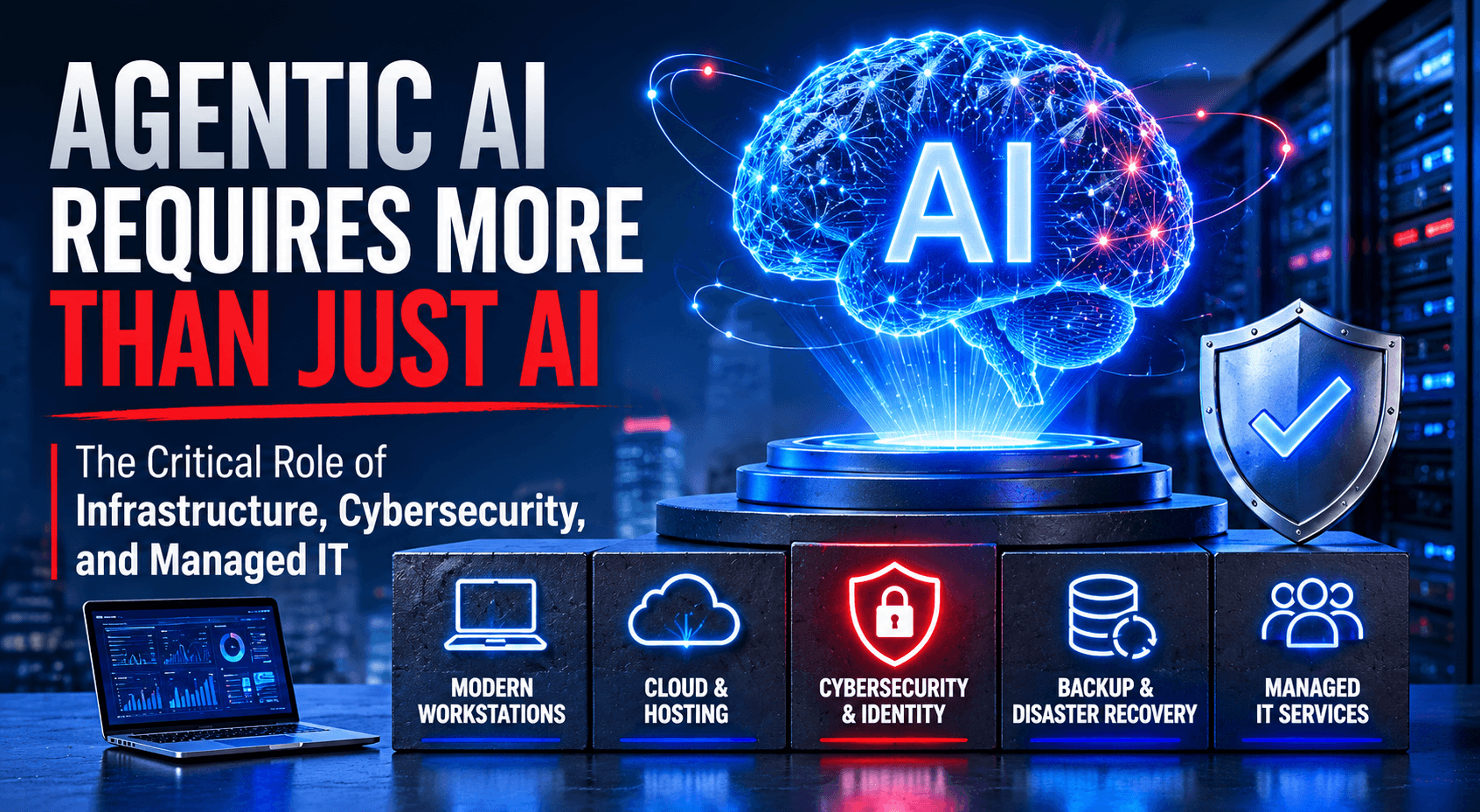
Agentic AI is quickly becoming one of the most talked-about technologies in business.
Organizations are exploring platforms like Claude, Copilot, ChatGPT, and other AI-driven solutions to automate workflows, improve productivity, accelerate decision-making, and create new efficiencies across their operations.
The opportunity is enormous.
But many businesses are focusing on the AI itself while overlooking the environment that supports it. That’s a mistake.
The organizations that achieve the greatest success with agentic AI will not simply be the ones that deploy it first. They will be the ones who build the right foundation underneath it.
Because Agentic AI does not operate in isolation.
It depends on your IT infrastructure, devices, cloud platforms, security controls, data center solutions, and business processes. If those systems are well managed, AI can amplify productivity and innovation. If they are not, AI can amplify operational and security risks just as quickly.
This is why AI adoption should be viewed as an IT strategy initiative, not simply a software purchase.
Agentic AI Changes the Technology Conversation
Traditional software waits for users to act. Agentic AI can take action itself.
Modern AI systems can analyze information, access business applications, interact with APIs, trigger workflows, and make recommendations across multiple systems simultaneously.
According to the NIST AI Risk Management Framework, organizations should evaluate AI systems not only for capability but also for governance, security, transparency, and operational risk.
As AI becomes more autonomous, infrastructure readiness becomes increasingly important.
The question is no longer:
“Can we use AI?”
The question becomes:
“Can our environment safely support AI?”
The Five Areas Most Businesses Overlook Before Implementing Agentic AI
Many organizations begin evaluating AI platforms before evaluating the environment in which those platforms will operate.
That often creates challenges later. Before implementing agentic AI, businesses should assess five critical areas.
Managed IT Services and Infrastructure Readiness
AI relies on the same infrastructure that supports the rest of your business.
That includes your network, cloud platforms, servers, end-user devices, collaboration systems, and business applications.
If those systems are outdated, poorly documented, or inconsistently managed, AI adoption often quickly exposes those weaknesses.
This is one reason organizations increasingly rely on Managed IT Services to maintain visibility, stability, and performance across their technology environments.
The reality is simple: AI can only perform as well as the infrastructure supporting it.
Cybersecurity and Identity Management
As AI gains access to more systems, cybersecurity becomes even more important.
In many ways, these AI systems function like highly privileged users.
Without proper controls, a mistake or compromise can affect multiple systems simultaneously.
Organizations implementing AI should prioritize:
- Multi-factor authentication (MFA)
- Role-based access controls
- Identity governance
- Endpoint security
- Continuous monitoring
According to CISA’s AI Security Resources, identity management, access controls, monitoring, and governance remain foundational components of secure AI deployment.
This aligns closely with the identity-first security approach behind well-executed Cybersecurity Services.
The more autonomy AI receives, the more important security becomes.
Hardware and Workstation Performance
One of the most overlooked aspects of AI readiness is the workstation itself.
Many businesses are attempting to deploy modern AI tools on aging hardware that was never designed for today’s cloud-first workloads.
Employees using AI-powered applications increasingly depend on systems with sufficient performance, memory, storage, and security to support modern workflows.
According to Microsoft 365 Copilot Documentation, successful AI adoption depends heavily on organizational readiness, secure access controls, modern infrastructure, and effective data governance.
Poor workstation and hardware performance can significantly impact user adoption and productivity.
The AI may be working perfectly. The endpoint may not be.
Cloud Solutions and Hosting Strategy
Agentic AI thrives on connectivity. It depends on access to data, applications, and business systems that often span multiple environments.
Organizations should evaluate whether their hosting strategy supports:
- Scalability
- Reliability
- Performance
- Security
- Business continuity
According to Gartner Artificial Intelligence Research, scalable and resilient infrastructure is increasingly becoming a prerequisite for successful enterprise AI initiatives.
Organizations adopting AI often discover previously hidden weaknesses in their hosting environments.
This is one reason businesses are reassessing their cloud strategy through solutions such as Cloud Solutions.
As AI adoption increases, infrastructure limitations become harder to ignore.
Backup, Recovery, and Business Continuity
Recent stories involving agentic AI deleting data, modifying environments, or making unintended changes have highlighted a critical reality: AI operates at machine speed.
When mistakes occur, they can happen faster than humans can react. Organizations deploying agentic AI should ensure they have:
- Isolated backups and recovery procedures
- Disaster recovery planning
- Business continuity strategies
- Ongoing system monitoring
According to CISA Cyber Resilience Guidance, resilience planning remains a critical component of modern cybersecurity and operational strategy.
AI does not eliminate the need for recovery planning. It makes it even more important.
AI Is Only as Good as the Data Feeding It
One of the most common reasons for AI projects failing has nothing to do with the AI itself. It has to do with data quality.
Many businesses still struggle with disconnected systems, duplicate records, inconsistent documentation, outdated information, and poor governance practices.
AI systems consume information at a scale humans cannot match.
If the data is inaccurate, incomplete, or poorly managed, the outputs will reflect those same problems.
IBM Artificial Intelligence Resources show that data quality remains one of the most significant factors affecting AI performance and business outcomes.
This is why many successful AI initiatives begin with improving data governance long before deploying autonomous agents.
Microsoft 365 Is Becoming an AI Foundation
For many organizations, Microsoft 365 is becoming the operational center of AI adoption.
Email, collaboration, file storage, communication, document management, and identity controls increasingly serve as the foundation for AI-powered workflows.
However, AI can only safely leverage Microsoft 365 when organizations have implemented:
- Proper permissions
- Data governance
- Secure sharing policies
- Identity controls
- Compliance management
Businesses evaluating AI should review their environment using well-exercised Microsoft 365 Solutions before expanding AI usage across the organization.
Why MSP Support Becomes More Important in the Age of AI
There is a growing assumption that AI will eventually reduce the need for IT teams and Managed Service Providers. The opposite is happening.
As businesses adopt AI, they often discover they need:
- More visibility
- Better monitoring
- Stronger cybersecurity
- Improved governance
- Better infrastructure management
- Strategic IT planning
This aligns directly with the Predictive IT philosophy behind:
The goal is not simply fixing problems after they occur. The goal is to identify infrastructure weaknesses, security gaps, and operational risks before they impact the business.
That becomes even more important when AI is involved.
The Real Competitive Advantage Isn’t the AI
Most organizations are focused on selecting the right AI platform.
Those choices matter. But they are not the most important factor. The organizations that realize the greatest value from agentic AI will be the ones that invest in:
- Managed IT Services
- Cybersecurity
- Cloud Solutions
- Business Continuity
- Infrastructure Management
- AI Governance
- Identity Security
Because AI is not a replacement for good IT. It is a multiplier of good IT.
Strong environments become stronger. Weak environments become more exposed.
Agentic AI Alone Isn’t the Solution, It’s Part of the Solution
Agentic AI has the potential to transform how businesses operate. But successful AI adoption requires more than software.
It requires secure infrastructure, modern workstations, reliable hosting environments, strong cybersecurity controls, quality data, and strategic oversight.
Businesses that approach AI as an infrastructure and cybersecurity initiative, not simply an automation project, will be far more likely to realize its benefits while avoiding its risks.
The organizations that succeed with AI over the next decade won’t necessarily have the most advanced AI.
- They’ll have the strongest foundation beneath it.
- That isn’t just good technology planning.
- It’s good business.
Are you exploring Agentic AI? We can help it function alongside your team, within a secure environment, with proper guardrails to ensure it is an asset, not a liability.
Contact us today to find out more.