
Businesses love data.
We track website visits, email opens, form submissions, sales opportunities, support tickets, advertising conversions, and CRM activity.
Then the phone rings.
A customer has a 15-minute conversation with someone on your team. They explain what they need, what they’re unhappy about, what they’re considering buying, and what they expect to happen next.
Then they hang up.
What happens to all that information? For many businesses, not much.
Maybe someone enters a note in the CRM. Or they jot something down. Maybe they tell themselves they’ll remember it later.
That’s a lot of valuable business intelligence to rely on memory for.
Your customers are already giving you data. The question is whether you’re using it.
Your Phone System Is Becoming a Data Source
We’ve talked before about why your VoIP AI solution shouldn’t sit in a silo.
Every customer conversation contains information.
- Why did they call?
- What problem did they have?
- What product were they interested in?
- Was the issue resolved?
- Did someone promise to follow up?
Traditionally, most of that information disappeared when the call ended. AI is beginning to change that.
Modern 3CX business communications can combine calling with AI-powered capabilities, CRM integrations, contact-center tools, and reporting. We help businesses deploy and manage those capabilities as part of a broader communications strategy.
That means your phone system can become more than a way to make and receive calls.
It can become a source of customer intelligence.
3CX Update 10 Makes Call Summaries More Useful
Call transcription was an important first step.
Instead of listening to an entire recording, AI can turn a conversation into searchable text.
Then came AI-generated summaries.
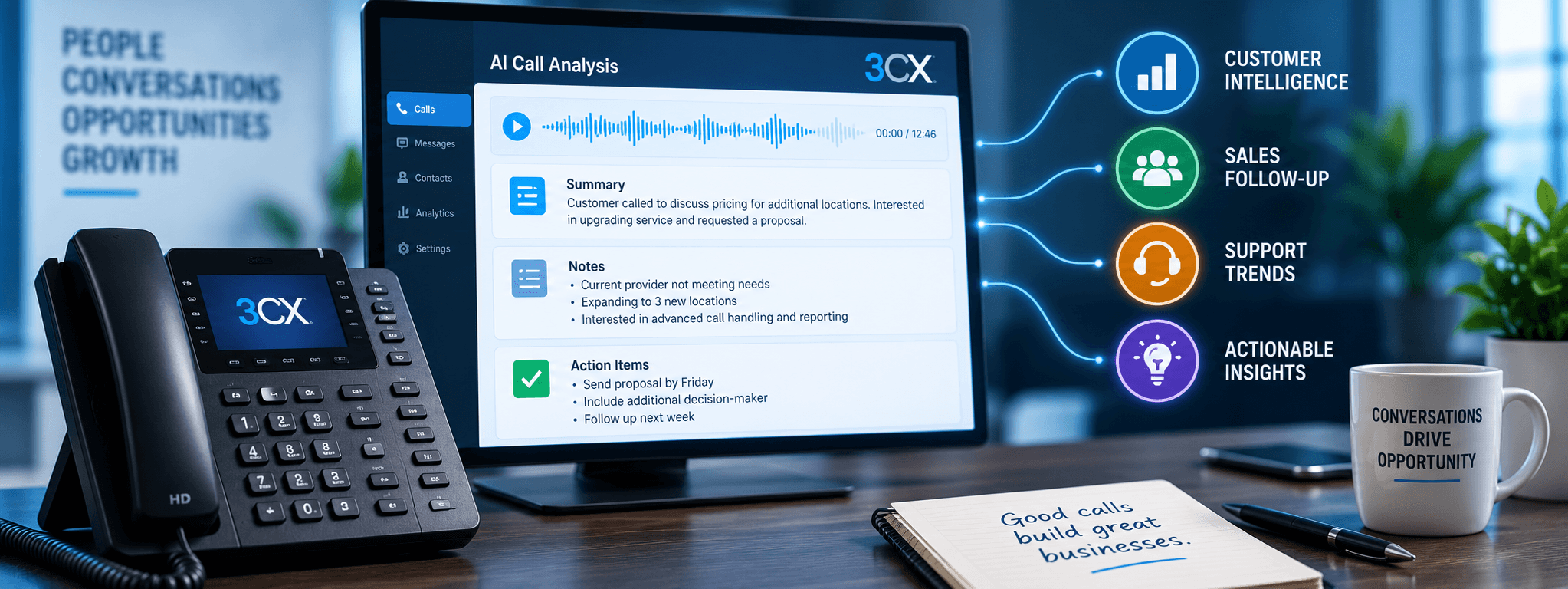
Now, 3CX Version 20 Update 10 is making those summaries more actionable by separating call analysis into three sections:
- Summary: What happened during the call.
- Notes: Important context, decisions, and useful details.
- Action Items: What needs to happen next.
3CX says the updated format is designed to help sales, support, and other teams quickly understand a call without replaying the recording or searching through the full transcript.
That sounds like a relatively small change.
It isn’t.
- A transcript tells you what was said.
- A summary tells you what happened.
- Notes tell you what matters.
- Action items tell you what happens next.
That’s where conversations start becoming usable business data.
Think About Your Sales Calls
Imagine a prospect calling your business.
During the conversation, you learn they’re opening another location in three months. They’re unhappy with their current provider. They need pricing by Friday. They also want another decision-maker involved in the next meeting.
That’s valuable information. Then your salesperson hangs up and jumps directly into another meeting.
Ideally, everything gets documented perfectly in the CRM.
In reality? We know how this works.
A few details make it into the CRM. A few stay in someone’s head. And occasionally, an important follow-up disappears completely.
AI-generated summaries and action items can create a useful first draft while the conversation is still fresh.
The employee can review it, correct anything necessary, and act on it.
3CX says supported CRM templates already allow AI-generated transcription, summaries, and sentiment information to be journaled with calls. Update 10’s more structured summaries can make those CRM records clearer and more useful.
That’s not replacing the salesperson.
It helps the salesperson remember what the customer actually asked them to do.
Now Look at Customer Support
The same concept gets even more interesting when you look across many calls.
One customer calls because they’re confused about an invoice. That’s a support call.
Fifty customers call about the same problem?
That’s a business problem.
Your support conversations may reveal patterns that aren’t obvious when calls are handled individually.
Customers may repeatedly ask the same question. They may…
- Struggle with the same process.
- Complain about the same product feature.
- Misunderstand something on your website.
Your team may repeatedly perform the same troubleshooting steps.
Individually, they’re conversations. Collectively, they’re customer intelligence.
We’ve already explored how AI-powered VoIP can provide transcription, summaries, sentiment analysis, and communication insights rather than simply routing calls.
Now businesses can start asking a better question: What are our customers trying to tell us?
Action Items May Be the Most Valuable Part
Knowing what happened during a call is useful. Knowing what should happen afterward may be even more valuable.
Think about how often employees say:
- “I’ll send that proposal.”
- “I’ll check with our technician.”
- “We’ll call when the replacement arrives.”
- “I’ll send you pricing.”
- “Someone from support will follow up.”
Every one of those statements creates an expectation. Every forgotten expectation creates a customer experience problem.
Update 10 is specifically designed to identify follow-up tasks from the conversation. 3CX also says the AI is instructed not to invent owners, dates, decisions, or tasks that weren’t established during the call.
If there isn’t a meaningful action item, it can simply report none. That’s important.
The goal isn’t for AI to invent more work.
It’s to make the work you’ve already committed harder to forget.
Better Information Can Create Better Customer Experience
Customers hate repeating themselves.
- They call Monday and explain the problem.
- They call Wednesday and explain it again.
- Then they get transferred and explain it a third time.
By then, they’re not frustrated with an employee. They’re frustrated with your company.
We’ve discussed this from another angle in AI Won’t Replace Your Employees. It Will Replace the Work They Hate Doing.
AI-generated call summaries can help employees focus on the conversation instead of frantically taking notes. They can also give the next employee useful context about what happened previously.
To the customer, the technology is invisible.
They simply feel like:
“This company remembers me.”
That’s a better customer experience.
Your Phone Calls May Be Market Research
Businesses spend a lot of money trying to understand customers.
- Surveys
- Analytics
- CRM platforms
- Focus groups
- Marketing research
- Customer experience software
Those tools can all be valuable.
But your customers are already voluntarily calling and telling you what they think. They’re telling you…
- What they want.
- What frustrates them.
- Why they’re considering your product.
- Why they aren’t ready to buy.
- What’s confusing.
That’s incredibly useful information.
The problem is that businesses have historically been terrible at capturing it.
AI transcription and analysis can make those conversations searchable, reviewable, and easier to connect with other business systems.
That’s why 3CX and AI-powered communications approach focuses on more than simply replacing an old phone system. Modern communication can connect voice, video, chat, CRM systems, customer support, reporting, and AI capabilities.
Don’t Let Your Phone System Live on an Island
A customer call doesn’t only matter to the person answering it. That conversation might also matter to…
- Sales
- Customer service
- Marketing
- Operations
- Management
- Training
That’s why integration matters.
Your VoIP and PBX environment should support how your business actually works, not exist as another disconnected technology platform.
A sales conversation might generate a follow-up. Or a support conversation might reveal a recurring issue.
A customer complaint might expose a broken process.
And what’s valuable to your marketing team is that a frequently asked question might become something an AI Customer Service Agent can eventually answer automatically.
This 3CX AI approach already includes answering common questions, gathering information, handling basic support, and handing conversations to employees when human expertise is needed.
Now the phone system is participating in the workflow instead of merely carrying the call.
There Is One Important Catch with AI and Business Data
If calls become business data, you need to treat them as such.
Recordings and transcripts can contain customer information, employee information, financial details, confidential discussions, and other sensitive data.
That means businesses should consider who can access recordings and transcripts, how long they retain information, where they process it, and what recording or consent requirements apply to their organization.
AI doesn’t eliminate those responsibilities. It makes them more important.
The goal isn’t to record everything simply because you can. The goal is to identify where conversation intelligence provides enough business value to justify collecting and managing that information responsibly.
Effective AI Starts with One Question
You don’t need to begin with AI. Start with something simpler:
What valuable information currently disappears when our phone calls end?
- Is it sales follow-up?
- Customer complaints?
- Support trends?
- Frequently asked questions?
- Customer sentiment?
- Promises employees make during conversations?
- Sales objections?
Pick one.
Then look at how transcription, summaries, action items, CRM integration, and reporting could help capture it.
That’s a much better AI strategy than turning on every feature simply because it’s available.
Your Customers Are Already Giving You the Data
That’s really the point.
- Customers are already talking to you.
- Prospects are already explaining what they need.
- Salespeople are already hearing objections.
- Support is already discovering what’s broken.
- Employees are already making commitments during those conversations.
The data is already there.
The question is whether it disappears when someone hangs up.
3CX Update 10’s new Summary, Notes, and Action Items format is a relatively small feature that points toward a much larger change.
Business communications are becoming less about simply connecting calls. They’re becoming about turning conversations into usable information.
That’s when your phone system stops being something you pay for because every business needs phones.
It starts becoming a source of customer intelligence.
Want to see what that looks like in practice?
Schedule a 3CX Communications Demo with Xecunet