
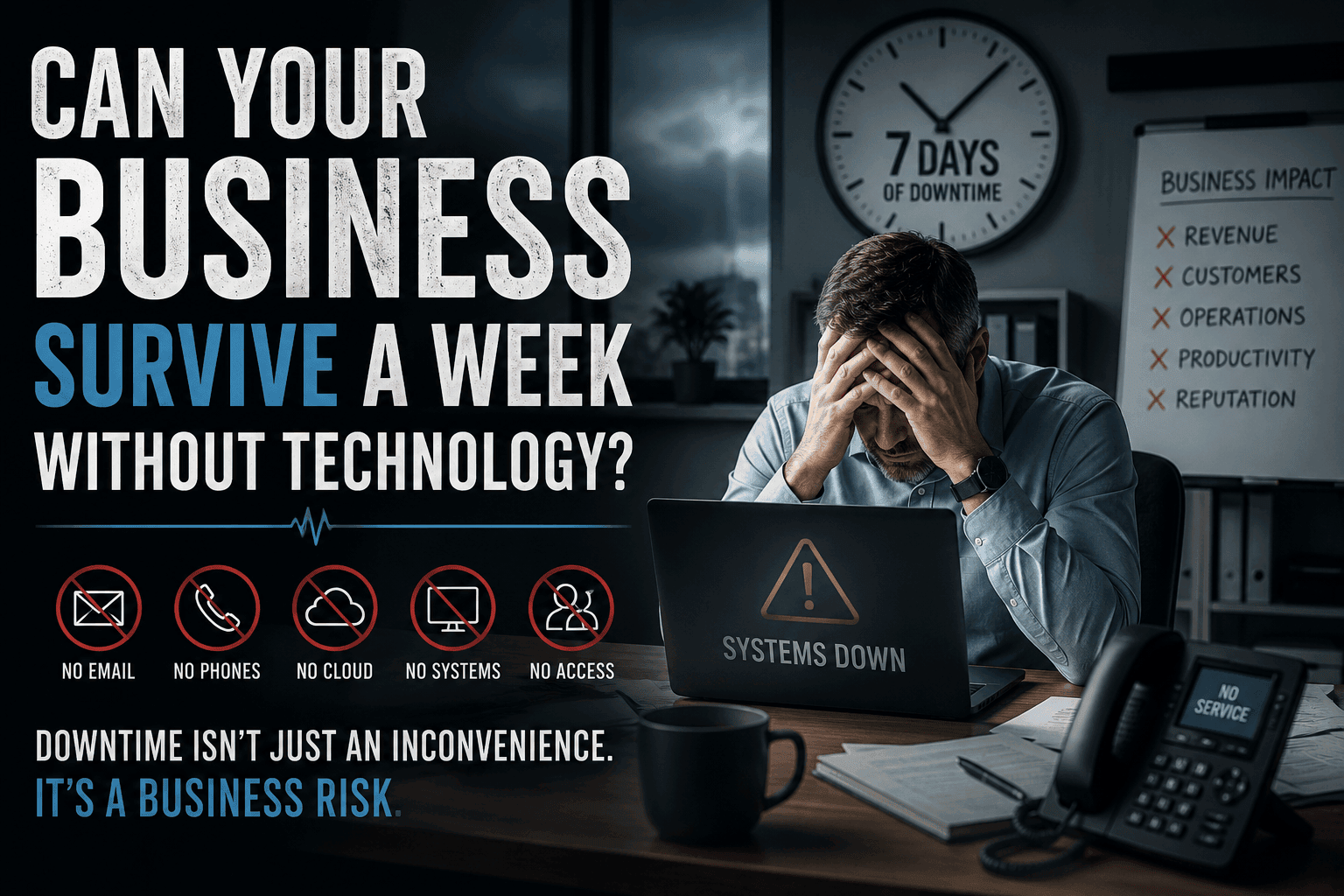
Imagine walking into your office tomorrow morning and discovering that nothing works…
- Your email is unavailable.
- Your phone system is offline.
- Employees can’t log in.
- Customer files are inaccessible.
- Your accounting software won’t open.
- Orders stop processing.
- Microsoft Teams won’t connect.
- Your website is down.
Now imagine it stays that way, not for an hour or a day, but for an entire week.
Would your business survive?
For many organizations, the answer is uncomfortable.
Technology has become so deeply integrated into daily operations that even a few hours of downtime can disrupt productivity, damage customer relationships, delay revenue, and create lasting operational challenges. Yet many businesses continue to operate without a tested business continuity strategy, thinking that backups alone will protect them.
Unfortunately, backups are only part of the solution.
We’ve found that the organizations that recover fast aren’t necessarily the ones with the newest technology. They’re the ones that prepared before disaster struck.
Business Continuity Is More Than Disaster Recovery
Many business owners use the terms business continuity and disaster recovery interchangeably.
They’re closely related, but they solve different problems.
A disaster recovery plan focuses on restoring your technology after a disruption. It addresses servers, applications, backups, and data recovery.
A business continuity plan focuses on keeping your business operating while that recovery takes place. It considers your employees, customers, communication, business processes, vendors, and technology together.
The National Institute of Standards and Technology (NIST) Contingency Planning Guide emphasizes that organizations should identify critical business functions, establish recovery priorities, and regularly test contingency plans before an incident occurs.
Recovery is important. Keeping your business running is even more important.
Technology Is the Backbone of Nearly Every Business
Most organizations don’t realize how dependent they’ve become on technology until it’s unavailable.
Consider how many essential business functions rely on IT today:
- Email and Microsoft 365
- VoIP phone systems
- Customer Relationship Management (CRM)
- Accounting and payroll
- Cloud applications
- Inventory management
- File storage and collaboration
- Cybersecurity tools
- Remote employee access
- AI-powered productivity tools
If several of these systems disappeared for a week, how would your employees communicate?
- How would customers reach you?
- How would invoices be sent?
- Would orders still be processed?
These aren’t hypothetical questions anymore.
Cyberattacks, hardware failures, severe weather, power outages, and human error continue to interrupt business operations every year.
Downtime Costs More Than Lost Productivity
When people think about downtime, they often think about employees sitting idle.
The real impact extends much further. A prolonged outage can affect:
- Revenue generation
- Customer confidence
- Employee productivity
- Regulatory compliance
- Vendor relationships
- Brand reputation
- Cash flow
- Long-term growth
IBM’s overview of Business Continuity says organizations that invest in business continuity planning are better positioned to recover from disruptions, and that the financial and operational impact of major incidents can be substantial. IBM also notes that preparation before an incident significantly improves organizational resilience.
The question isn’t whether your business will experience disruption.
It’s whether you’ve prepared for it.
Ransomware Has Changed the Conversation
Not long ago, disaster recovery primarily meant restoring systems after a hardware failure or natural disaster.
Today, ransomware has fundamentally changed the recovery process.
Organizations can’t simply restore yesterday’s backup without first confirming that systems are secure, credentials haven’t been compromised, and attackers no longer have access.
The recovery process now involves:
- Incident response
- Security validation
- Identity verification
- Backup integrity
- System restoration
- Business continuity
As noted by CISA and reinforced by NIST guidance, organizations should integrate cybersecurity, incident response, business continuity, and disaster recovery into a coordinated resilience strategy rather than treating them as separate initiatives.
Recovery today is as much about restoring trust as it is restoring technology.
Could Your Employees Continue Working?
Imagine your office loses access to every core system.
- Would employees know what to do?
- Could they continue serving customers?
- Could your leadership communicate with employees?
- Would remote workers have secure alternatives?
- Would customer support continue?
These questions reveal the difference between having backups and having a business continuity strategy.
Technology recovery alone doesn’t automatically restore business operations.
Organizations also need documented procedures, communication plans, recovery priorities, and clearly defined responsibilities.
Building Resilience Before You Need It
The organizations that recover fastest typically prepare well in advance of an emergency.
An effective business continuity strategy often includes:
- Risk assessments and Business Impact Analysis (BIA)
- Secure cloud and off-site backups
- Immutable backup strategies
- Business Continuity and Disaster Recovery (BCDR) planning
- Cybersecurity protections such as EDR, MFA, and identity management
- Redundant internet connectivity
- Cloud-based communications
- Regular disaster recovery testing
- Employee security awareness training
- Continuous monitoring and proactive IT management
These capabilities are supported through our:
- Managed IT Services
- Cybersecurity Services
- Cloud Solutions
- Business Continuity & Disaster Recovery
- Microsoft 365 Solutions
Together, they help organizations reduce risk while improving operational resilience.
IT Preparation Is a Competitive Advantage
Many businesses think of business continuity as an insurance policy. In reality, it’s a competitive advantage.
When competitors struggle to recover from unexpected disruptions, resilient organizations continue serving customers, supporting employees, and protecting revenue.
- Customers remember which businesses remained available during difficult situations.
- Employees appreciate organizations that have a plan.
- Leadership gains confidence knowing the business can withstand unexpected events.
- Business continuity isn’t simply about surviving disasters.
It’s about maintaining trust.
Technology Should Never Become a Single Point of Failure
Modern businesses depend on technology more than ever before.
Cloud computing, AI, Microsoft 365, VoIP, cybersecurity platforms, and remote work have created tremendous opportunities for growth. They’ve also increased our dependence on reliable infrastructure.
Technology failures may be inevitable. Business failure doesn’t have to be.
By combining proactive IT management, cybersecurity, secure cloud infrastructure, tested recovery plans, and ongoing monitoring, organizations can significantly reduce the impact of unexpected disruptions.
Every Company Is Now a Tech Company
Technology has become the foundation of nearly every business process.
The real question isn’t whether your organization will experience an outage, cyberattack, or unexpected disruption.
It’s whether your business can continue operating while technology is being restored.
If the answer is “I’m not sure,” now is the time to ask a different question:
“What would happen if your business had to operate without technology for an entire week?”
The organizations that answer that question before disaster strikes are almost always the ones that recover the fastest.
If you are asking if you’re sure or not, we should talk.